


The spoiler-free (in intent) annotations continue. This section (of Foucault’s Pendulum) is really long, so I’m dividing it into two installments. You can find the previous four installments here. I hope you’re reading along!
p. 217
•Gevurah: The left arm of God (Hesed is the right). Strength, bravery, wrath, fire. A check or boundary holding back on the awful expansiveness of the divine. To get from Hesed to Gevurah, one travels west, again the opposite of Casaubon’s travels between books.
Chapter 34
p. 219
•epigraph: Here is the Picatrix (p. 165). The Latin reads (after the litany of demonic names): “Come quickly with your spirits.” This particular demonic litany (which recalls or does not the one on p. 132) also appears in Peter Ackroyd’s novel Hawksmoor (1985).
•Breaking of the Vessels: In addition to being a core kabbalistic concept (explained in the next few paragraphs), this is also the title of a 1982 book of poetry criticism by Harold Bloom.
•reshimu: I’m not the person who’s going to be able to say somethng interesting and original about kabbalism, but can we perh. cf. the Rebis (p. 344 etc.)
•seashells: See coquillage marin, p. 201.
•Fu Manchu: The arch-villain of Sax Rohmer’s pulp fiction. Note that FP is always flirting with being pulp fiction and that Rohmer claimed to be a Rosicrucian.
p. 220
•Adam Quadmon: Usu. Adam Kadmon, “primordial man,” and anthropomorphism of divine light. Cf. William Blake’s Albion.
•events in Italy: These were the Years of Lead so-called, when radicals from both sides of the political spectrum engaged in terror campaigns.
•Amazonia: The Amazon rain forest, o.c., and perh. more specifically a Brazilian national park. This somewhat idiosynchratic term reappears on p. 274.
•Fortaleza: A coastal city in Brazil.
p. 221
•O homem que matou Moro: Port., “The man who killed Moro.” Aldo Moro, a center-left politician, was kidnapped and murdered by Communists in 1978.
•poster of Che: Che Guevara, Argentinian revolutionary, or rather his inescapable face, posterized ca. 1968 by artist Jim Fitzpatrick
•Nietzsche and Céline: Friedrich Nietzsche and Louis-Ferdinand Céline; both right-coded writers (although only Céline really fits the bill).
•transcendental meditation: Meditation technique of Maharishi “Sexy Sadie” Mahesh Yogi. Trendy among hippie and New Age types in the 1960s and 1970s.
•macrobiotic: Zen-based diet also trendy in the 1960s and 1970s.
•Lichtenstein: Roy Lichtenstein, artist known for copying and blowing up (uncredited) comics panels. Not that I’m bitter.
•machines with fluorescent screens: The pinball machines have been replaced with video games.
•Planet X: Canonical term for a hypothetical planet on beyond Neptune, or perhaps anywhere. Marvin the Martian and Daffy Duck, e.g., battle over Planet X.

•frogs: Doubtless the 1981 console game Frogger.
•Red Brigades: The communist side of the conflict in the Years of Lead.
p. 222
•Space Invaders: 1978 console game. “I’d kill my mom for a chance to play.”
•”you can’t play pinball with a pistol stuck in your belt”: See immediately below, Belbo’s writing on hips; but with all the symbolic overtones.
•Tilt: The Plot is of course an attempt to massage history without becoming ludicrous…to tilt it, in other words, but without the attempt registering upon the machine (this effort fails).
•homeopathy: see p. 213
•against nature: À rebours, the Huysmans novel last referenced on p. 16.
•vis movendi: Force of motion. The term dates back at least to Kepler.
•“immemorial lengths of time”: Presumably “my most immemorial year” (E.A. Poe).
•ileum: This is a part of the small intestine; presumably Belbo meant ilium, the hip bone.
•Amazon: Note that this is only two pages after an appearance of the other meaning of Amazon.
p. 223
•“the machine as metaphor of the cosmic body”: The cosmic body is, o.c., already a metaphor. This whole passage is perh. too on-point.
•alien faces: Not literally, but also as in Space Invaders?
•Che: see p. 221
•“one drop every six months”: Even slower than the Pendulum (reimagined here as a water clock?).
•Chandos: see immediately below, p. 224
p. 224
•cyclical crises: Just underlining the word cyclical.
•Hofmannsthal: The Lord Chandos Letter is a 1902 work by Hofmannsthal in the form of a fictional letter by a fictional lord (addressed to Francis Bacon, q.v. on pp. 8, 10, etc.). The letter is about language and its limits; what this has to do with economics I do not know.
•French collaborationists: Céline, perh.; see p. 221.
•Albanian political texts: Albania would have been Communist at this time. From Céline to Communism is a polar shift.
•Anselm of Canterbury: Anselm (see p. 65) was born in the Italian city of Aosta, but was also Archbishop of Canterbury (installed four years after the Norman Conquest).
•Dixie cup: Casaubon presents a hard-boiled detective scenario (see pp. 12, 29, etc.) undercut by the cheap, tiny, cute, disposable Dixie cup.
•Avicenna: 11th-century Muslim polymath last mentioned on p. 89.
p. 225
•taxidermist’s: Taxidermists furnish one of the traditional accoutrements of sorcerers. Smollett speaks of the “apparatus of a magician, such as globes, telescopes, a magic-lanthorn, a skeleton, a dried monkey together with the skins of an alligator, otter, and snake [etc.]” (Peregrine Pickle (1751); emphasis added). Cf . The Quacks Academy (1678): “Any sexton will furnish your window with a skull, in hope of your custom; over which hang up the skeleton of a monkey, to proclaim your skill in anatomy.”
•A. Salon: Merely a punning name, but also traditionally a place to discuss philosophical matters (as on p. 64); more, in other words, than just a taxidermist’s.
•Marlowe: See p. 29, and always remember that Kit Marlowe (no relation) is the author of Dr. Faustus.
•Laplace, Kant: The Kant-Laplace nebular hypothesis is a cosmogonal theory seating the origin of the solar system in a nebula; named for the two philosophers, Pierre Laplace and Immanuel Kant, who proposed it.
•Königsberg: Home of Kant, the “sage of Königsberg.” Seven bridges in Königsberg crossed the Prengel River.
•seven bridges: A prototopological mathematical problem, solved by Euler: Kant on his stroll cannot cross each bridge only once.
•Mannerism: 16th-century art movement. Its link to the Idea is not so clear to me, but perhaps comes through the Neoplatonist critic Lomazzo?
•“no piece of information is superior to any other”: An important rubric for 1. the paranoid worldview (cf. Eco’s work on “paranoid readings”) and 2. the construction of the Plot.
Chapter 35
p. 226
•epigraph: This is the Mandelbaum translation of these lines:
Whoever asks my name, know that I’m Leah,
and I apply my lovely hands to fashion
a garland of the flowers I have gathered.
Note in Italian Leah is Lia, like the FP character.
p. 227
•Yeats: W. B. Yeats, the great Irish poet. This fact reappears on p. 425.
•Stella Matutina: Morning Star (i.e. Lucifer); a group that only comes in for censure in FP; see pp. 284 & 584.
•Sam Spade: see p. 12 etc.
•Maltese falcon: See p. 28, but also cf. the Knights of Malta.
p. 228
•“I quoted him”: Who is “him”? In context it would seem to be Sam Spade, but did Spade ever say that?
•bon pour vous: Fr., good for you.
Chapter 36
p. 229
•epigraph: Burton’s passage tells of a self-fulfilling prophesy, just as (all of) FP does.
•Vagnère: see p. 110
•epicurean: Only in the loose, modern sense of the word. Epicurus was quite abstemious in his habits.
p. 230
•diabolical Doktor Wagner: Playing up his association with Faust (see p. 107n).
•“Who, on that gray morning of”: This sentence fragment recalls (i.e. prefigures) the opening of Eco’s 2010 novel The Prague Cemetery: “A passerby on that gray morning…”. Of course, Belbo is always teasingly writing badly.
•satanic: Another Faustian echo.
•Charlus, Jupien: Two characters from Proust. In Sodom and Gomorrah, Charlus compares his seduction (?) of Jupien with a bee invading a flower.
•deontologically: Deontology asserts that ethics are based on duty or rules. Are I crazy in seeing a pun off de…ntology (the study of teeth) and “bites” in the next line?
•Quatre-vingt-treize: Ninety-three, Victor Hugo’s final novel.
p. 231
•philter: A love potion, which naturally ties into the ongoing alchemical theme. Love philters will appear again on p. 348.
•“I had just given up drinking”: see p. 65
•“call him three times”: Like Candyman / Bloody Mary / Hastur / etc.
p. 232
•Cecilia/sax player: see p. 330
•La psychanalyse…ça ne colle pas: Fr., Psychoanalysis? What it comes down to is, between men and women…my dear friends…it just doesn’t work.
•“the viscount started, as if bitten by an asp”: Belbo’s prose is getting purpler.
p. 233
•Mackie Messer: A.k.a. Mack the Knife
•“you were at home, and with the Other”: Is he addressing Lorenza?
p. 235
•epigraph: Hagigah is a book from the Mishnah, which is itself part of the Talmud. Hagigah primarily deals with glossing Genesis.
•Conservatoire des Artes et Métiers: The place the book starts; see p. 7.
•“Is this all?”: Cf. Peggy Lee.
p. 236
•null pole: Cf. p. 327.
•Carmagnole: French Revolutionary song.
•Vendée: Counterrevolutionary region, or even pseudo-state, existing in opposition to the then-current French Revolution. Presumably the path from Carmagnole to Vendée is just 1960s radicalism dulling its radical edge (Belbo’s explicit charge a few paragraphs down and cf. p. 224).
•equinox or a solstice: The vernal equinox begins spring, which ends at the summer solstice.
•“rite of…spring”: Hidden in the text is Stravinsky’s controversial 1913 ballet.
•killed in Hungary: Presumably in the 1956 uprising (crushed by Soviet tanks).
•fanzines: Fanzines, being explicitly amateur (and implicitly anti-corporate), homegrown affairs, seema bad example for Belbo to use here. Perhaps he means fan magazines (Photoplay etc.)?
•Zen and the art of motorcycle maintenance: Treated here as two items but o.c. the title of a 1974 bestselling novel.
p. 237
•Bolivian militia: Presumably a reference to the death of Che Guevara at the hands of Bolivian Rangers.
•“Every point of the universe is a fixed point”: Cf. “no piece of information is superior to any other” on p. 225.
•special places: An explicit refutation (“nobody would believe that”) of telluric current theories.
p. 238
•scrofula: A royal touch traditionally heals scrofula, which is known therefore as “the king’s evil.” Antimonarchist wags assert that scrofula is the only disease whose name is a redundancy.
Chapter 38
p. 239
•epigraph: Although treated as a quote, this is merely a list.
•The Poetic Athanor: An athanor is an alchemical (!) oven.
•The Italic Parnassus: Parnassus is the mountain upon which the Muses live. Italic must mean Italian but I like to imagine it just means an really emphasized Parnassus. You know, like Parnassus!!
•Manutius: see p. 149
•The Flower Unplucked: A reference to Frost’s “Asking for Roses”: “A flower unplucked is but left to the falling.”
•Terra Incognita: Unknown land.
p. 240
•“nonfiction, I believe”: Very dry, very funny.
•New Atlantis: Another reference to the Bacon book (pp. 8 & 200).
•Königsberg Revisited: Kant again (v. p. 225); he wrote Prolegomena to Any Future Metaphysics (1783). “Phenomenal noumenon” is an oxymoron.
•pelican: In medieval legend, a mother pelican pierces her own breast to feed her young with her blood.
•D’Annunzian motto: This phrase is associated with the Italian writer Gabriele d’Annunzio.
•Grazia: Italian for “grace”; it is also the name of an Italian women’s magazine. Note that for all her blandness, Grazia wears a designer scarf and suit.
•Palazzo Venezia: Mussolini’s headquarters (as implied in the previous sentence). IIRC, this is a setting in Eco’s last novel (Numero Zero).
•globe: Putting the monde in Garamond?
p. 241
•Magdeburg hemispheres: A popular apparatus for scientific demonstrations back in the day; named for the original 1654 experiment in performed in Magdeburg, Germany (by the mayor).
•Madame Curie: Needless to say, Garamond’s account is not strictly accurate.
•hydrocarbon: “Petroleum, natural gas, and coal” (Wikipedia), and also o.c. a kind of compound in orgo.
•golconda: A city in India but presumably Garamond (and Eco) is thinking of the 1953 painting by Magritte.

•phlogiston: A hypothetical and obsolete substance that makes flammable items burn. No longer a recognized scientific possibility.
p. 242
•de Ambrosiis: His only appearance, IIRC.
•Svevo: Italo Svevo, author of the (much-lauded) Zeno’s Conscience (1923).
•incipit: First few lines.
•cela dit: Fr., that said.
p. 243
•Balzac, Proust, Joyce: Am I wrong in detecting more Proust and Joyce than Balzac in Eco?
Chapter 39
p. 245
•epigraph: Well, just see p. 239; Memphis-Misraim and Scottish are two different Masonic rites. “Shepherd King of the Hutz” is perh. more commonly rendered “Pastor-King of the Hutz.” Note the “Orphic”: named for Orpheus, his Ancient Mysteries.
•“the fear that They will find me”: Note the capital They.
•Floriana: I had assumed Eco had in mind the Thorgal character, but in retrospect I don’t think she appears until 1992 (but post hoc ergo ante hoc). Perhaps, given all the Maltese Falcon references, it matters that Floriana is a city in Malta?
•Cosmoranto: Cosmos + Esperanto.
•UNESCO: The United Nations Educational, Scientific and Cultural Organization.
•“except Ivy Compton-Burnett”: Huge dis to Louisa May Alcott, Harriet Beecher Stowe, and Francis Hodgson Burnett.
•Nerval: Gérard de Nerval, pen name of Gérard Labrunie, nineteenth-century Romantic writer.
p. 247
•Lampedusa: Extremely famous Italian writer.
p. 249
•Paris is well worth a mass: Supposedly spoken by Henry of Navarre, who converted to Catholicism to become king of France (1593).
p. 250
•ça va sans dire: Fr., It goes without saying.
•Corriere della Sera: Large Italian newspaper.
Chapter 40
p. 251
•epigraph: The quotation continues: “The valiant never taste of death but once.” Proverbial.
•ideal observation point: Belbo’s ongoing refusal to do, but only to observe. Also cf. Casaubon’s earlier/later location in the periscope.
•“She kisses me as if she were playing pinball”: I.e. while moving her hips. See p. 222.
p. 252
•Hölderlin: German Romantic poet. What he has to do with the visual arts I do not know.
•the man with the scar: Belbo’s life takes on the form of bad melodrama.
•masked avenger: Traditional term for a superhero. Note that Superman does not wear a mask.
Chapter 41
p. 254
•epigraph: Daath, oft. Da’at, is the invisible non-sefira “skipped over” on p. 159. To be clear, Daath appears as a labeled circle on the tree of life, but it does not count as a sefira…rather it is the place where all ten sefirot are united (although not all sefirot literally intersect or “touch” Daath).
•Doré: Gustave Doré, French engraver who illustrated, among other books, Dante’s Divine Comedy. I once attended a lecture in which a critic complained…that while Doré’s illustrations for the Inferno were inspired, his illustrations for the Paradiso amounted to (and I quote) “fat Beatrice on a cloud.” Apparently Garamond disagrees.
•ça va sans dire: A favorite phrase of Garamond’s. See p. 250.
•UNICEF: The United Nations Children’s Fund (it stands for United Nations International Children’s Emergency Fund). Garamond always brings up the UN (see p. 245)! Does he see the Red Cross and UNICEF as cultural institutions? Prob. he just means that his is not a charity.
p. 255
•d’Artagnan: One of the Three Musketeers (sc. the Fourth).
•Mandrake: …the Magician. Comic strip superhero. He shares a thin mustache with d’Artagnan.
•Philosophia Moysaica: 1638 text by Robert Fludd (see p. 197 etc.).
•unguentum armarium: This is in fact, a good part of the plot of Eco’s next novel, The Island of the Day Before.
•Volta and Marconi: Alessandro Volta and Guglielmo Marconi, inventors of the battery and the radio respectively.
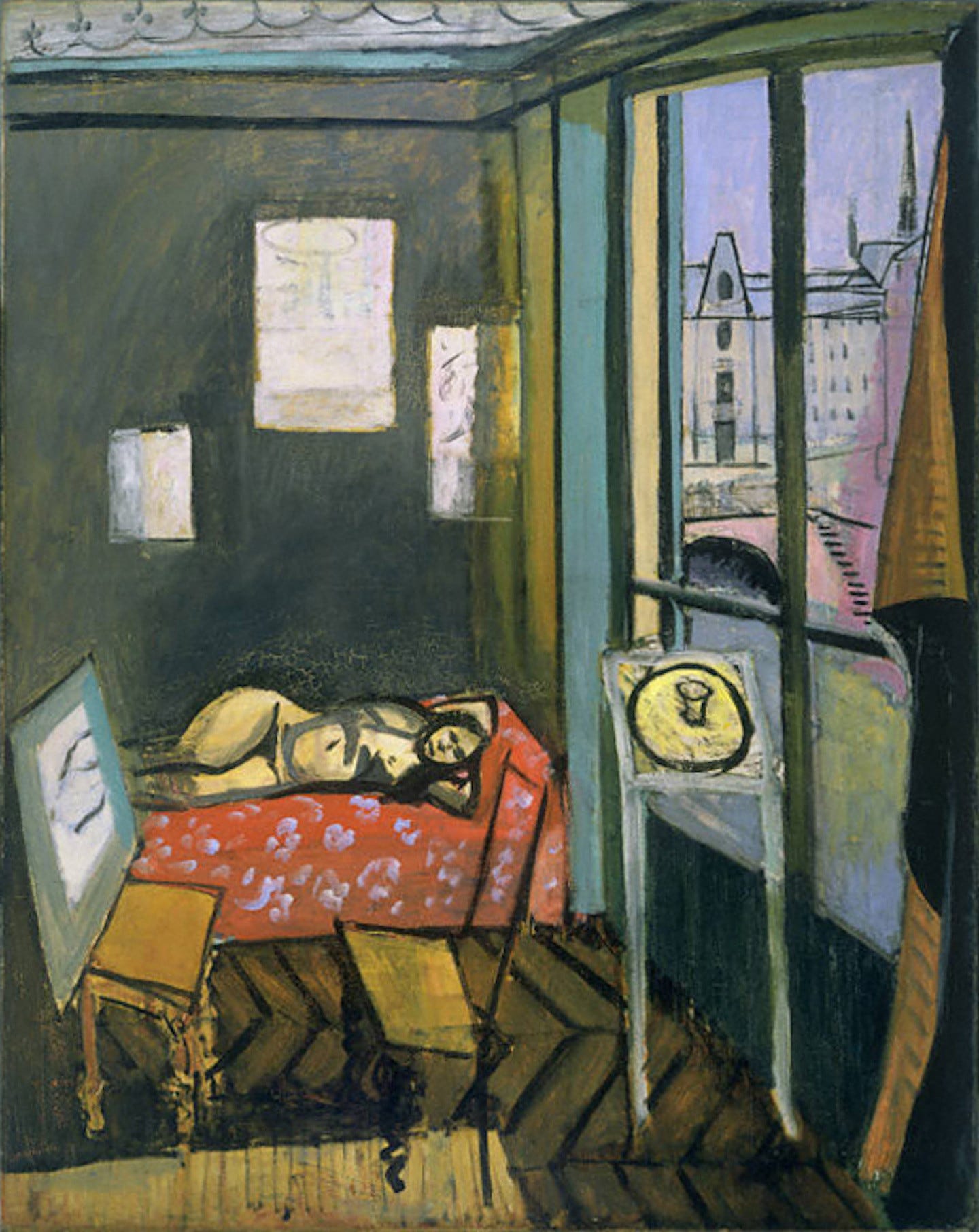
•quai Saint-Michel: Just a place in Paris on the Seine. Here’s one by Matisse titled Studio, quai Saint-Michel (1916).
p. 256
•split hairs: Once again, see tetrapyloctomy, p. 74
•Rosa rosarum: Lat., Rose of roses. I am not clear on what his means in context.
•“…like revolutionaries, eh? Those days are past.”: see p. 236.
•couchette: Sleeping berth in a train.
•tapir: The comparison is made on p. 202.
•De Amicis: Another one-off name, much like the similar de Ambrosiis on p. 242.
p. 257
•decans: see p. 283
•book of Azoth: Azoth is the alchemical universal solvent, or perh. just another name for mercury. Paracelsus had the word engraved on his sword. A book titled Azoth is quite explicitly the subject of the 1619 volume below, but perhaps it can refer to or be inspired by the 1613 publication Azoth, sive Aureliae occultae philosophorum by Basilius Valentinus?
•“expert in magiam, in necromantiam, etc.”: This look like weird or bad Latin; one expects in magia, in necromantia, etc., as the way it stands (magiam, necromantiam) it would mean “an expert into magic, into necromancy” and so on…obvious nonsense. BUT as it turns out, the “in” is plain English, and necromantiam, etc., is the way Staurophorus lists the sections of the book of Azoth (with slight differences: e.g. Staurophorus writes magicam, not magiam). All b/c Eco refuses to italicize other languages!
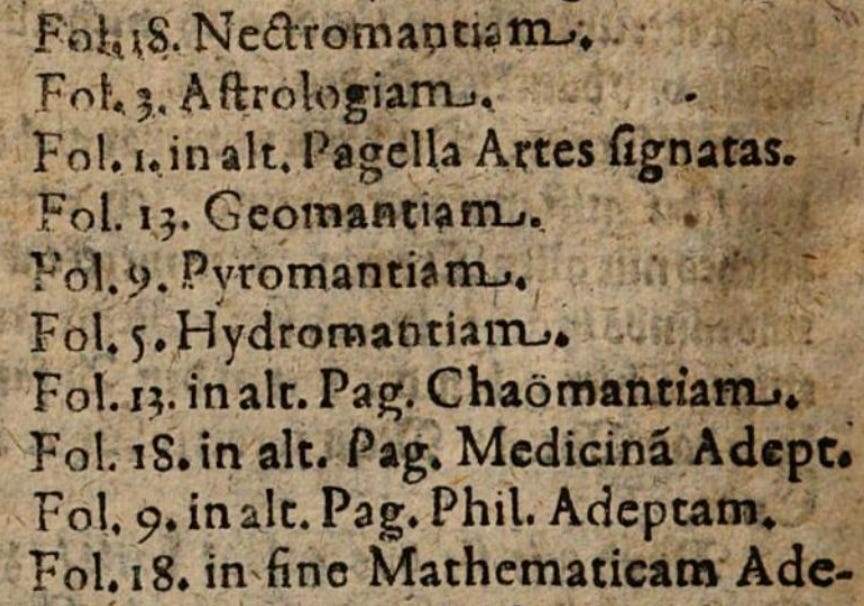
•Staurophorus: Rhodophilus Staurophorus, pseudonymous author of Raptus Philosophicus, subtitled (in German): That Is, Philosophical Revelations Set Forth Quite Simply and Plainly, and Humbly Inscribed to the High and Renowned Fraternity K.C. The book does indeed describe how the author was (among many marvels) given a book titled Azoth.
•psychurgy: “Mental operation or activity” (OED).
•arithmology: “A treatise on numbers, or statement bearing upon them” (OED).
•auras: Paranormal (and originally Theosophical) energy fields detectable as emenating from the human body.
•fluids: Fluids? Fluids?
•psychometry: “Divination of facts concerning an object or its owner through contact with or proximity to the object” (MW).
•the five hyperphysical senses: Are these the five sense extended in some way beyond the physical, or are they five all-new senses?
•physiognomics: The study of discovering character by examining appearance.
p. 258
•spagyrics: Paracelsian method “to improve the efficacy of existing medicines by separating them into their primordial elements…and then again recombining them” (Wikipedia).
•evocatory magic: Spells from the invocation/evocation school. (Ha ha.)
•theurgy: The magical technique of compelling powerful (usu. benign) beings to serve. Contrasts with goety (see p. 271) or goetia. Presumably “voluntary theurgy” (below) is the same but without the compulsion?
•gymnosophy: see p. 25
•Memphis hieroglyphics: Ancient Memphis has its literal hieroglyphics, of course, but also see the epigraph, p. 245.
•onomancy: Divination by names.
•prophetic furies: As the wrath of the OT prophets, or of Luther.
•somnambulism: see the epigraph, p. 170
•mercurial chemistry: A vanilla chemistry term, but please remember that mercury is Azoth, and in alchemy is both a symbol of transformation and one of the “tria prima” (essentially, three elements) of Paracelsus.
•Wronski: Józef Wroński, nineteenth-century polymath whose thought influenced Éliphas Lévi.
•possessed nuns of Loudun: In 1634, some Ursuline nuns in Loudun, France, claimed demonic possession; the resulting witch trial burned a priest.
•the convulsives of Saint-Médard: “A group of 18th-century French religious pilgrims who exhibited convulsions and later constituted a religious sect and a political movement” (Wikipedia).
•elixir: see p. 14
•arsenic water: A nostrum for treating ulcers and cancers in various Pharmacopoeiae Chirurgicae, such as this one.
•Eurynomius: Eurynomos, a demon mentioned n Pausanias.
•agathodemons: Ancient Greek tutelary deities.
•Mithra: Presumably Mithras. Perhaps these carelessnessnes on Bramanti’s part (cf. Eurynomius above) are intentional on Eco’s (but see p. 265n).
•Morpheus: The son of Sleep in Ovid; he had no ancient mysteries.
•Samothrace: Site of an extra-mysterious ancient mystery dedicated to the Cabeiri or the Great Gods.
•Eleusis: Queen of the mysteries. “The words of Herakles when he was not /Allowed to be initiated into the Eleusinian Mysteries: /’I was initiated a long time ago.’”
•Wood of Life: Lignum vitae, a hardwood tree; note that lingum is nearly lingam. The name evokes as well the Tree of Life.
•Key of Science: Couldn’t this be just anything? Maybe we should wonder what we’re getting out of Bramanti’s frenzied catalog. Did Eco just want to vomit out everything occulty he could think of? I mean, yes, and that is FP, but I mean in microcosm.
•Baphomet: see pp. 103-04
•mallet: Just as a phallic symbol?
•Ceres: Demeter, one of the foci of the Eleusinian Mysteries.
•Cteis: “The Cteis was a circular and concave pedestal, or receptacle, on which the Phallus, or column [obelisk] rested” (Pike, 1871).
•Patera: Roman libation bowl, often with a little navel (omphalos); apparently a yonic symbol.
•Cybele: Anatolian goddess imported to Rome in the form of a meteor.
•Astarte: Another name for Ashtoreth (p. 199).
Chapter 42
p. 260
•epigraph: Turba Philosophorum = Crowd of Philosophers. Early (tenth century?) alchemical book.
•cork: see p. 56
•gnostic novel: The Name of the Rose, written, indeed, by a famous critic (Eco o.c.) and set in an abbey recalling Turin’s Sacra di San Michele.
•gnoseology: The study of knowledge, but cf. E. A. Poe:
‘My son,’ said he, when we were seated, ‘what is the chief end of your existence?’
‘My father,’ I answered, ‘it is the study of Nosology.’
‘And what, Robert,’ he inquired, ‘is Nosology?’
‘Sir,’ I said, ‘it is the science of Noses.’
•geomancy: In retrospect, Bramanti could not have named geomancy, because that would have struck too close. To keep silent!
•maalox: Trade name for an antacid. Now we’re just being sily.
•mercurial Radames: Radames is a character from Aida; presumably Garamond is just coupling a hermetic sounding word and an Egyptian-sounding name.
•another book, by a famous journalist: I cannot find this book (assuming it is real). Turin is noted for its connections with the occult (“Italy’s capital of the occult”). Several sites mention it is part of two magical triangles, a white magic triangle with vertices at Turin, Prague, and Lyon, and a black magic triangle with vertices at Turin, London, and…San Francisco? What kind of monstrously acute angle is that?
•city of the automobile: In the same way that in the US Detroit is the Motor City.
p. 261
•satanic rites: Here Garamond has the bourgeois prejudices.
•six or seven years ago: Another indication of the changing times in Italy: the (violently) political book shops have become new age shops.
•Tupamaros: Uraguayan guerrilla group. Satisfying Garamond’s requirements, they were both Marxists and terrorists.
•Hermes: Garamond flubs again. (He is described two ¶¶ later as “missing the reference.”)
•The golden branch: Frazer’s golden bough (see p. 12). “The Golden Branch” is also how Andrew Lang (in The Red Fairy Book) translates Madame d’Aulnoy 1697 fairy tale “Le Rameau d’or.”
p. 262
•the lottery: Always a reference either to Shirley Jackson or Borges.
•rodent: Tapirs are not rodents, but Garamond is hardly a stickler for accuracy.
•Tabula Smaragdina: The Emerald Tablet so-called of Hermes Trismegistus. See pp. 283, 400, & 449.
•Isis Unveiled: The title of an 1877 Theosophical text by Madame Blavatsky. “The veil of Isis is a metaphor and allegorical artistic motif representing the inaccessibility of nature’s secrets” (Wikipedia).
•Tutankhamen: In the timeline of FP, we would be during or shortly after King Tut’s relics’ tour of West Germany. At least in the US, such a tour sparked Tutmania.

•the scarab of the pyramids: Garamond seems to have just linked the first two (or perh. the 2nd and 3rd) Egyptian-sounding things he could think of.
•“Project Hermes…will strengthen the flow of ideas”: Hermes is o.c. the god of messengers and commerce.
Chapter 43
p. 264
•epigraph: Huysmans is (more cryptically) referenced on pp. 16 & 222.
•Hermeticist Dr. Moebius: Clearly a reference to comics artist Jean Giraud, author of Le Garage Hermétique (The Airtight Garage, but more hermetic in French).
•dépliant: Fr., leaflet.
•Pentacle of Solomon: Solomon with a five-pointed star is not without precedent in occult writing, but Solomon’s seal is usually six-pointed. Perh. another solecism of Garamond’s?
p. 265
•Asian swastikas: Both the Nazi and the Hindu swastika “spins” clockwise. The idea that Nazis flipped the Swastika (to make it evil) is an old urban legend.
•“There are more things in heaven and earth”: From Hamlet. “...than are dreamt of in your philosophy.”
•“evil genius of the Raja of Assam”: I assume more an evocation of pulpy writing than any specific reference.
•Editions Henry Veyrier: Éditions Henri Veyrier was a French publishing house and, apparently, book store (of used and rare books?).
•Jesuits: Certainly a focus for the conspiracy-minded, Cf. Pynchon’s Sino-Jesuit conspiracy in Mason & Dixon.
•Opus Dei: Another Catholic organization. Prob. more famous now than it was upon FP’s publication, thanks to Dan Brown. Mel Gibson is not a member.
•Carbonari: Nineteenth-century Italian revolutionary societies. Why are they in a contemporary directory? Prob. the only place they have been linked to Rosicurcians, etc., is in chapter VII of Immortal Lycanthropes.
•Rotary: The least secret of secret societies, a service nonprofit. At times, various anti-Masonic types (incl. The Catholic Church) have lumped Rotary International under the rubric of fraternal organizations. See p. 388.
•that French anthropologist: Claude Lévi-Strauss. Garamond misses the Levi (see p. 161) reference.
•a detective story: A Study in Scarlet (1887), the first Sherlock Holmes novel. The irony is o.c. that the Mormons are the easiest to determine and assert the existence of of any group on this list.
•Church of Mithra: Again, prob. Mithras. Perh. this is another of Garamond’s misreadings, but prob. a translation artifact, as Italian sources use the form Mithra.
p. 266
•Vril: An energy source in the 1871 novel The Coming Race by Edward Bulwer-Lytton. The concept of vril was embraced by Theosophists, but rumors of Vril-based organizations in Nazi Germany, although widespread, are poorly sourced.
•“Do all those really exist?”: Well, the Mormons do. I’ll admit that after failing to establish the extranovelistic bonafides of several groups I gave up.
•Tupamaro: see p. 261
•Picatrix: see p. 165
•gods of the underworld: Back to the subterranean theme.
•ectoplasm: Occult substance; some spirits drape themselves in ectoplasm to take a physical form.

p. 267
•homunculus: see p. 347
•Faust…Helen of Troy: What Faust did with Helen of Troy can be called “making a homunculus” only in the world of euphemism.
•secreted: Contains the word secret = occult.
•joss sticks: Incense sticks, from the Portuguese deus, God. Note the olfactory appeal.
•“faces exactly like professional sorcerers”: see physiognomics, p. 257
•beard: see p. 79
•facies hermetica: Lat., hermetic face. The first appearance of what becomes an in-joke among the trio.
p. 268
•sticks of incense: More olfactory.
•ivory hand: The hamsa hand so-called.
•legion: Apt for Diabolicals: “My name is Legion: for we are many” (Mark 5:9).
Chapter 44
p. 269
•epigraph: The Enochian text is translated by Dee, something like: “I rayng ouer you, sayeth the God of Iustice, in powre exalted above the firmaments of wrath: in whose hands the Sonne is as a sword and the Mone as a throwgh thrusting fire.” (I say “something like” because I don’t know where the Enochian ends. Note that Crowley (who appears below) had a notebook titled Ol Sonf Vorsg (similar to Ol Sonuf Vaorsag above); also that he was kicked out of the Order of the Golden Dawn (whence this rite comes) quite literally—kicked down the stairs by Yeats.
•OTO: Before Crowley assumed control, the OTO had been an offshoot of Masonry, something like the Shriners.
•Aleister Crowley: The wickedest man in the world so-called.
•Liber AL vel legis: The Book of AL [i.e. El = God] or of the Law. The idiosyncratically capitalized AL has several additional occult significances (o.c.).
p. 270
•crossing my fingers: To ward off evil.
•Hoor-paar-Kraat: I.e. Harpocrates, Hellenistic god of secrets, and also Horus. Ra-Hoor-Khuit is another form of Horus, at least in Thelemic (i.e. Crowleyan) ritual.
•Liturgy of the Sword: Perh. a parody of the Liturgy of the Word?
•Mahapralaya: The cyclical (!) apocalyptic dissolution of the entire Hindu cosmos.
•Third Eye of the Kundalini: For the third (pineal) eye and Kundalini (together!) see p. 104.
•congressus cum daemone: Lat., conference with a demon. Crowley uses this phrase as part of the subtitle of his summoning ritual Liber Samekh.
p. 271
•goety: Black (or “low”) magic; contrasts with theurgy (p. 258).
•Bas-Aumgn: Spirits (?) invoked in the Liber Samekh. “Ye that are Gods, going forth, uttering AUMGN.”
•Sa-Ba-Ft: Another Liber Samekh spirit (?). “Nuith! Hadith! Ra-Hoor-Khuit! Hail, Great Wild Beast!”
•out of the ordinary: A good euphemism.
Chapter 45
p. 272
•epigraph: Terra senza tempo = Timeless Land. Peter Kolosimo is one of the first “ancient astronaut” writers.
•Mu: Hypothetical lost continent in the works of several early C20 writers but esp. James Churchward, who situated it in the Pacific.
•Chichén Itzá: Large, ruined Mayan city.
•spit and image: The older form of the phrase spitting image; presumably Belbo is honoring the obsolescent.
•“he find serpent worship…common origin”: Cf. Lessing, Laocoön (1766): “For there must certainly be a reason why the adulterous phantasy was never anything but a serpent.”
•“Except, of course, the Chosen People”: Diotallevi has forgotten Nehushtan, the bronze serpent, erected by Moses in the desert. Hezekiah “brake in pieces the brasen serpent that Moses had made: for unto those days the children of Israel did burn incense to it” (2 Kings 18:4).
•Kaly-yuga: Usu. Kali Yuga, the fourth, final, and worst age of the Hindu cyclic calendar.You are here. It lasts 432K years, and has a ways to go.
•the decline of the West: The title of Spengler’s magisterial volume. This is the second time (see p. 210) Spengler has been accused of Nazism.
•gnomes, undines, salamanders…sylphs: For Paracelsus, creatures representing the four elements, respectively earth, water, fire, and air.
p. 273
•Nibelungs: See p. 72. In rejecting books for being too Nazi-adjacent, perh. one should not immediately invoke Wagner.
•Little People: It will be challenging performa reading of Irish mythology that separates the fairies from the little people.
•Columbus’s real aim: This is not quite the thesis of Michael Bradley’s The Columbus Conspiracy (1992)…but it’s not so far off.
•Hebrew letters…dream books: Why do dream books ahev Hebrew letters in them?
•Lourdes: French pilgrimage destinations, site of several miraculous appearances of Mary in 1858.
•Saint-Germain: He reappears, still dropping names: Benjamin Franklin and the Marquis de Lafayette.
•“the atom, a Jewish lie”: Atomic theory goes back to the pre-Socratics, but perh. that’s not what is meant.
•Fortian sciences: Usu. Fortean. Fort’s reputation has only grown since his death, and most fans seem to have the same half-skeptical, half-satirical view of facts that Fort did.
p. 274
•“spacecraft in prehistoric times”: See, that’s the kind of thing Peter Kolosimo would write about!
•thirtieth parallel: Actually it is at 29.9792458°, which is the speed of light (in a vacuum (!)) in m/second. But cf. p. 15: “the secret of the pyramids is revealed if you don’t calculate in meters but in ancient cubits.”
•“What does Quetzalcoatl have to do with Amazonia”: Casaubon has, o.c., been to Amazonia, and speaks of what he knows. Quetzalcoatl is the Mexican plumed serpent god.
•Aztlán: I’m sure this connection is made by everyone, but I’ll give one example: Species with Amnesia: Our Forgotten History by Robert Sepehr.
•yod: First letter in the Tetragrammaton.
p. 275
•“The Egyptians knew electricity”: Thus answering the question raised on p. 272.
•“I saw that in a movie”: Raiders of the Lost Ark (1981).
•Porsena: Etruscan king who warred with and later befriended) Rome.
•Szmrszlyn Khraznapahwshkij: One wonders how Casaubon (? unspecified) managed to pronounce this name on the fly.
•Sibylline books: Oracular books describing the fate of Rome. Most of them were burned by the Sybil as a negotiating tactic while haggling over the price with the king of Rome.
•Lilith the Talmudic demon: Adam’s first wife, turned bad.
•hermaphroditic great mother: Several sources point to the Solomon Islands as having a belief in a hermaphroditic great mother. I assume this is coincidence, but…Solomon (!) Islands!
•Marx and Nietzsche…angelology: Marx and Nietzsche were both quite explicitly atheists.
•Kant and occultism: Always connections with Kant (see p. 225). At least one writer, Ayn Rand, did see Kant as an occultist, in the sense that he hypothesized a noumenal world.
•Eleusian mysteries: Usu. Eleusinian (see p. 258).
•Cagliostro: see p. 165
•atomic energy: If this is also a Jewish lie (see p. 273), its proximity to the golem, a Jewish monster with truth on its brow, is interesting.
•Sacred Heart: The heart of Jesus as a symbol of God’s infinite love. Recall back on p. 171 the “sweetish spray cans labeled ‘Sacred Heart of Jesus’” Casaubon purchases.
p. 276
•Iamblichus: Neoplatonist philosopher; wrote a biography on Pythagoras.
•lured to a flower: Return of the Charlus & Jupien reference (p. 230).
Chapter 46
p. 277
•epigraph: This ritual is “Liber LXX”, or “The Cross of a Frog.”
•redivivus: Reborn.
•agitated voices: The squabble will prove to be between representatives of two different Satanic sects, the Order of Satan and the Luciferine Church; a parody, perh., of the internecine squabbles among very similar branches of (homoousios v. homoiousios) more mainstream religions.
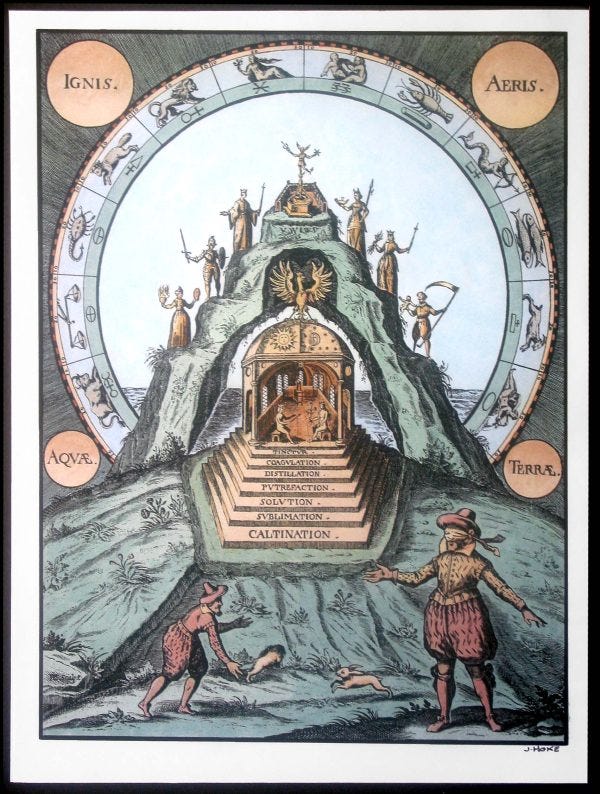
•seventeenth-century print: Perhaps the one below (Stefan Michel Spacher, 1616).
•Bramanti…devils: Like Camestres (p. 271), Bramante has out-of-the-ordinary means.
p. 278
•Pierre: Pierre is never called anything but by this name. It o.c. corresponds to Peter, the rock on which Jesus built his church, but prob. it is just a generic French name rendering Pierre semi-anonymous. A parody of a Frenchman?; certainly Pierre slips into French more than other characters.
•hosts: Communion wafers.
•bon: Fr., all right.
•Eclise Lucifrienne: Luciferian Church.
•tauroboliaste: Fr., taurobolist; a participant in an ancient Roman bull sacrifice (associated with Cybele or perh. Mithras).
•psychopompe: Fr., psychopomp; a guide to the underworld for the newly dead. Trad. Hermes.
•Grand Tenancier du Mal: The grand proprietor of evil.
•pyxes: Containers for the consecrated host.
•comment dit-on: Fr., how do you say it?
•chasubles: Catholic liturgical garments.
•Adonai: The God of the Bible. Pierre is expressing a Gnostic philosophy here.
•principe: Fr., principle.
•Luciferre: This seems to be just emphasizing how Pierre pronounces his dark lord’s name.
•Mais voyons: Fr., Oh, come now!
•envoûtement: Fr., enchantment.
•Dogma and the Ritual of High Magic: see the epigraph, p. 161
•Our Lord: Freudian slip for a Satanist.
•Du Sangreal Bookshop: The Sangreal is the Holy Grail.
p. 279
•chocs: Fr., shocks.
•bibelots: Knicknacks, tchotchkes.
•alembiques: (Usu. alambiques, but:) Fr., alembics (aka limbecks); alchemical distilling devices. “Her limbecks dried of poisons / And the knife at her neck” (Housman).
•plaster Baphomet: For Baphomet see (again) pp. 103–4. I am beyond delighted to learn that Pierre’s plaster Baphomet is a memento of my late father.
•ordures: Fr., filth.
•hein?: Fr., eh?
•cataplasms: Poultices.
•jury d’honneur: A jury called to determine questions of personal honor; specifically (tho’ not here) one to determine guilt in Vichy collaboration.
•Martinists of Lyon: Lyon is a French city just a couple of hours from the Italian border. For Martinists se p. 209n, although there are many kinds of Martinists and I lose track.
•enfantine: Fr., infantile.
•sorcelery: Apparently an anglicization of Fr. sorcellerie, sorcery.
•voyante: Fr., seer, clairvoyant.
•crached: Crache is Fr. for spit, so with the Eng. suffix we have “spat.”
•Huysmans: J.-K. Huysmans from p. 264, etc., again. Huysmans himself eventually converted to Catholicism and became a Benedictine oblate.
•ouaise: Fr., yeah.
•carnival of Venise: Why does this phrase anger Bramanti so? Is it just that the carnival (only recently (in ’79) revived when FP takes place) is a tourist trap, or kitsch, or in some sense false? Or is it Pierre’s affected way of misspelling Venice just to remind everyone that he’s French?
p. 280
•goety: See p. 271.
•parquet: Fr., floorboards.
•diablotine: Fr., little devil; used to refer to naughty children.
•Carmelite scapular: The brown scapular, so called; a pair of cloth amulets worn over the head as a devotion to Mary.
•contresign: Fr., counterspell.
•envoutement retourne, ah oui: Fr., The Hex had backfired, yes.
•mauvais moment: Fr., a bad time of it.
•“we all belong to the same spiritual knighthood”: Cf., again, Carlyle, quoted before in the notes to p. 177: “Are not all true men that live, or that ever lived, soldiers of the same army, enlisted, under Heaven’s captaincy, to do battle against the same enemy, the empire of Darkness and Wrong?”
•vulgar Freemasons: see Great Orient, p. 281.
•Boito’s Mefistofele: An 1868 Italian opera based on the Faust legend.
•“Ha…brocanterie”: Fr., Ha, well said. That’s just a load of junk.
•poltergeist: The rational explanation.
•astral conjuncture: Usu. conjunction. Two or more celestial bodies lining up.
p.281
•merchants of the Great Orient: The Grand Orient is the largest French Masonic organization. Presumably “merchants” is just a slur against the vanilla nature of Freemasonry (compared to true initiates).
•Bien entendu, le rituel, ah ça: Fr., of course, the ritual, oh that.
•“no longer the days of Crowley”: Presumably referring to the hostile conflicts in wh. Crowley (kicked down the stairs by Yeats) found himself. O.c., again and again in this section we are reminded that these are no longer the Years of Lead so-called.
Chapter 47
p. 282
•epigraph: Delminio’s book describes a Theater of Memory, a kind of reverse theater (the spectator stands in the center and beholds concepts arranged in the stands (cf. Agliè’s little study, p. 283). More information here.
•crepuscular: I prob. should have been keeping track of all the times the lighting is something liminal, like twilight or dusk, but I guess it’s too late now.
•double-mullioned window: Two adjacent windows with a mullion (vertical support) between.
•diamond panes: A reference to Borges’s “Death and the Compass.”
p. 283
•polychrome: Painted, as on p. 182.
•one of those renaissance fantasies: E.g. Delmino’s from the epigraph.
•sylloge: A collection or compendium.
•the palace of Mantua: The Palazzo D’Arco hosts the Sala dello Zodiaco by Falconetto (ca. 1520) featuring decans; there may be others in Mantua, as decans were a Renaissance staple.
•thirty-six decans: “Groups of stars (small constellations) used in ancient Egyptian astronomy to conveniently divide the 360 degree ecliptic into 36 parts of 10 degrees each, both for theurgical and heliacal chronometrical purposes” (Wikipedia).
•salamander: see p. 272n
•a taxidermist friend: A. Salon, presumably. See the note for p. 225.
•aeolipile of Hero: Also called Hero’s engine, and usually involving heating water, not air; a simple steam-powered device.
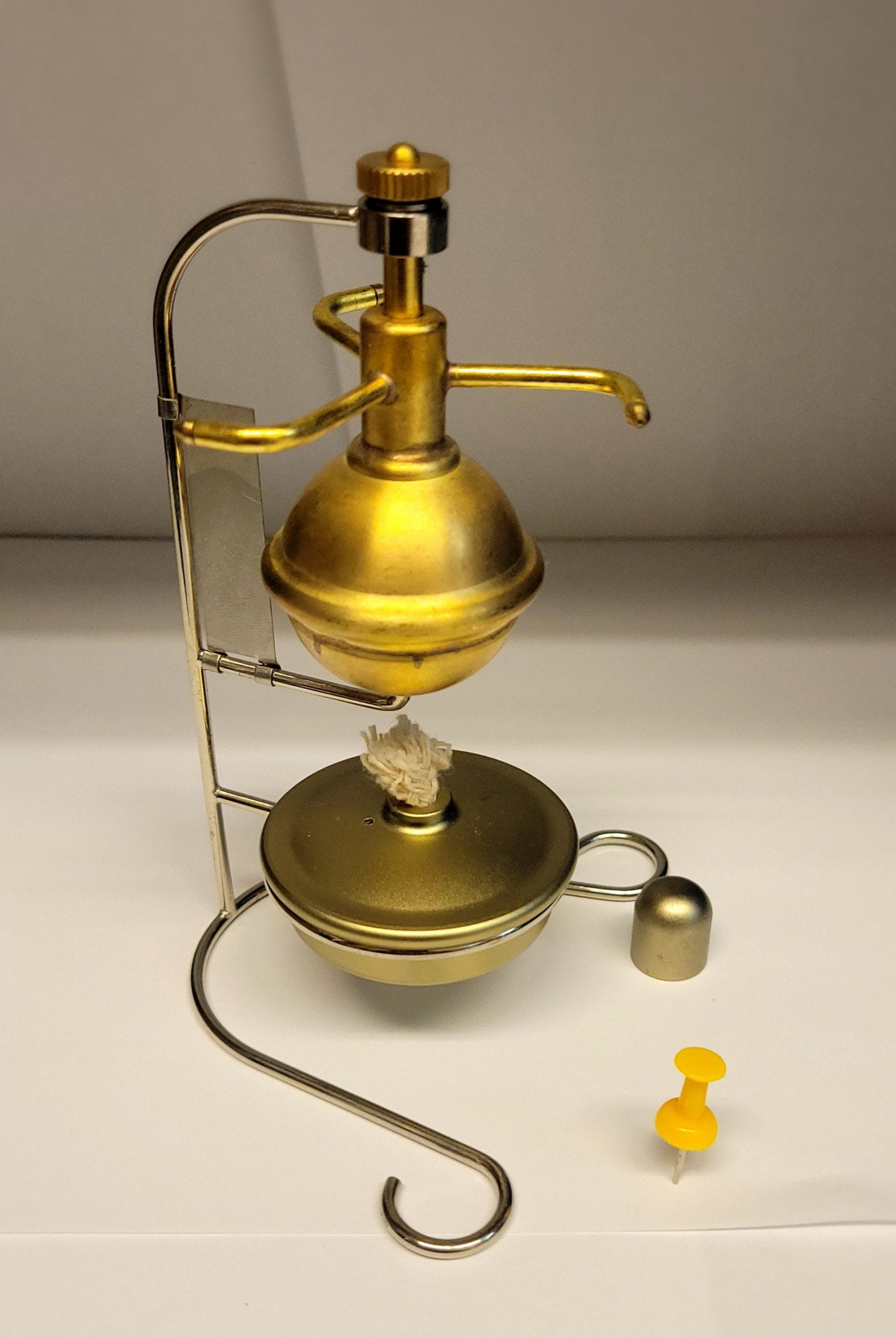
•claim a miracle: A commonplace among early Christian texts (as in (pseudo-?)Hippolytus’ Refutation of All Heresies) is that pagans, esp. perh. Egyptians, used a series of cunning legerdemains to make spurious miracles.
•golden law: I’m neither sure what this law is, not why it should be a law of earth and fire, and not fire and water or fire and air (depending on the type of aeolipile). It is perh. important, given our earlier adventures in Brazil, that the Golden Law (Port., Lei Áurea) is the 1888 law abolishing slavery (in Brazil).
•cyclotrons: Particle accelerators. Lamestream physics.
•“I know better than the so-called learned”: See again Tom o’ Bedlam’s mad song, quoted in the notes to p. 185.
•As it is below, so it is above: An inverted version of the second line of the Tabula Smaragdina (see p. 262).
p. 284
•Oedipus Aegyptiacus: Only the third volume of this vast tome of Egyptiana deals with hieroglyphics.
•Horapollon: Author of the Hieroglyphica (ca. 490), an eafrly and mostly incorrect explanation of hieroglyphics. His book is widely quoted.
•museum of wonders: Kircher curated a wunderkammer, or cabinet of wonders, that became the Kircherian Museum; eventually dispersed (1916).
•Champollion: Jean-François Champollion, French philologist who translated hieroglyphics with the aid of the trilingual Rosetta Stone. Agliè’s reaction is quite characteristic of him.
•Amphitheatrum sapientiae aeternae: Amphitheater of Eternal Wisdom, a Christian alchemical text, richly illustrated. Only two copies of the first edition (there are others) indeed exist; “This is the third” is a perfect joke.
•Burnetius: Latinization of Burnet; this book is quoted on p. 125, q.v.
•Traicté des Chiffres: Treatise on Ciphers. The Vigenere cipher so-called (misattributed) proved uncrackable for over 300 years.
•Kabbala denudata: Translated by Mathers as The Kabbalah Unveiled.
•McGregor Mathers: Founder of the Golden Dawn; his translations (esp. of the Key of Solomon) are inescapable.
•British esthetes: Yeats called out!; but there are others (Machen e.g.).
•Stella Matutina: see p. 227
•vice anglais: The English vice; masochism.
p. 285
•queste du Graal: The quest for the Grail of course, Fr., but the wording does not seem to correspond perfectly with any of the major Grail texts (La Queste del Saint Graal or La Quête du Saint Graal, e.g.g).
•narwhal’s horn: Tusk, o.c.; traditional fake unicorn horn.
•extremes meet: Alchemical union of opposites (but also modern horseshoe theory).
p. 286
•Pyramidion: The pointy capstone of a pyramid. Cheops’ pyramidion has been missing for millennia.
•Carnarvon: Lord Carnarvon sponsored the expedition that uncovered King Tut’s tomb. He died two months after the opening of the tomb.
•Herodotus: The ancient Greek historian described the history and construction of the pyramids, although there’s nothing really implausible (or hermetic) in his accounts.
•Piazzi Smyth: Charles Piazzi Smyth, British astronomer who also dabbled in pyramidometry. Inventor (discoverer?) of the “pyramid inch,” useful to future pyramidometrists. Note that just as with the Anselm of Canterbury / of Aosta controversy (p. 224), Eco, or Casaubon his narrator, or the author of the MS. under consideration, has dropped the Charles to give Smyth a more Italianate name. (Smyth was named for his godfather, Italian astronomer Giuseppe Piazzi; he was also born in Naples.)
•convert to…cubits: See p. 15.
•“Tell me how you—”: How does he do it, folks? The answer is directly below.
•reading, in those images: The explicit purpose, o.c., of a memory palace.
Chapter 48
p. 287
•epigraph: There’s Piazzi Smyth (from p. 286)! Note that regardless of whatever snark I’ve indulged in, Smyth credited himself, in editions published in his lifetime, either as C. Piazzi Smyth or just Piazzi Smyth.
•cinematheque: This is an extremely strange word choice.
•Yankee Doodle Dandy: Cagney, as George M. Cohan: “Oh, I am proud. In fact, I’m flabbergasted. First time in my life, I’m speechless.”
p. 288
•Quid est veritas: Lat., What is truth? The “friend” is Pontius Pilate (John 18:38). The Latin famously anagrams into an answer to the question: Est vir qui adest, or It is the man who is here (i.e. Jesus).
•Flinders Petrie reports: AFAICT, this is a calumny of Agliè’s (although Petrie’s measurements did contradict Smyth’s).
•measure that kiosk: This is a precursor to Lia’s bravura analysis on pp. 534ff.
•victory at Poitiers: When Charles Martel defeated an invading army from Caliphate Spain.
•Jean-Pierre Adam: An actual architect and archaeologist, but I cannot find his kiosk measurements, if true.
p. 289
•tout se tient: Fr.: “everything is connected,” as on p. 179
•Marconi: see p. 255
•Chaldean priests: Presumably not merely religious leaders of the Chaldeans but mystics in the tradition of the Chaldean Oracles, a pseudoneoplatonic poem. Proclus was wont to say that, given his druthers, he would destroy, as inimical to humanity, all books except Plato’s Timaeus and the Chaldean Oracles.
•Karnak: see p. 167
•Thebes: The Egyptian, not the Greek city (presumably).
•open sesame: The magic words from Ali Baba and the Forty Thieves. “Open, sez me,” says Popeye.
•telluric currents: Cue musical sting.
•Sophia: see p. 15
Chapter 49
p. 292
•epigraph: Traditio templi = tradition of the temple; Temple et contemplation = (o.c.) Temple and Contemplation. “This volume brings together five lectures which were originally delivered at different sessions of the famous Eranos Conferences in Ascona, Switzer#2;land [sic]” (publisher’s website).
•***: see p. 60
•Canepa: At last the reference on p. 43 is explained.
p. 294
•La Stampa: “One of Italy’s oldest and most prominent national newspapers” (Wikipedia).
•partisan: see p 58
•Badoglian: General Pietro Badoglia became PM of Italy after the fall of Fascism; a Badoglian would be anti-Fascist.
•Mongo: The planet (ruled by Ming the Merciless) on which Flash Gordon adventures.
•Flash Gordon: Another of Eco’s frequent references to comics.
•Carabinieri: Italian military police. I always confuse this with Carbonari, which made A Farewell to Arms hard to understand.
p. 296
•“bayonet attack on Saint Crispin’s Eve”: Surely a reference to the “band of brothers” monolog on St. Crispin’s Day in Henry V.
(49 is a good place to stop, for inveraritious reasons. More TK!)