Gevurah is the length of a novella on its own, so no regrets on breaking it into two parts. First Gevurah post is here. Other links to previous chapters at the end!
If you find these annotations useful, please consider purchasing one of the books I wrote, or buying me a coffee (tea, most likely).
Chapter 50
p. 297
•epigraph: Nag Hammadi is an Egyptian city near which a collection of ancient gnostic texts were discovered in 1945. This epigraph comes from “The Thunder, Perfect Mind.” See also p. 41n for biblical parallels.
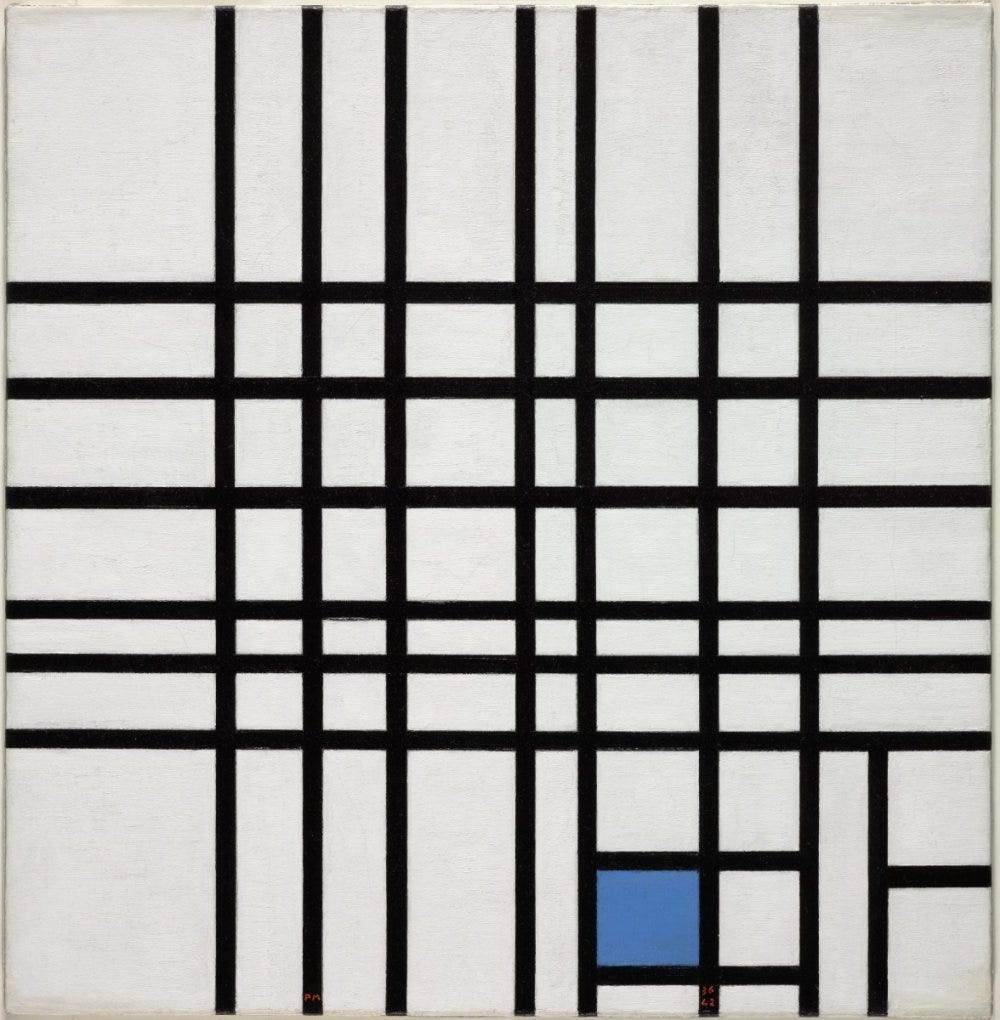
•Composition 15, Parallax 17, Euclid X: The changing titles Riccardo gives to his paintings offer if not a history of avant-garde art in the latter half of the twentieth century, at least Eco’s satirical impression of it. These titles are similar to several by Piet Mondrian, which puts Riccardo several decades behind the times.
•squats: Unofficially or illegally occupied buildings. Associated with the left on p. 315.
•Ce n’est qu’un debut: Fr., This is only the beginning. A catchphrase of the (quasi-revolutionary) French protests of May, 1968. The next few titles will be politically engaged, left-coded, and at least quasi-revolutionary.
•Molotov: Both the long-lived and unrepentantly Stalinist Soviet politician—and the eponymous improvised weapon favored by street-fighting types.
•A Hundred Flowers: “Let a hundred flowers bloom,” Chairman Mao said in 1956, signaling that differing viewpoints were now permissible and people could freely criticize the Party. Of course a year later the blooming flowers were culled.
p. 298
•In Praise of Ambiguity: Perh. a reference to Empson’s Seven Types of Ambiguity (1930)?
•A/Travers: A travers is Fr. for “through,” here leaning into a post-structuralist love of dividing words with slashes or parentheses.
•Ça: Fr., that.
•Denegation 15: Cf. Riccardo’s Composition 15, above.
•Megale Apophasis: The Great Declaration, a sacred text of the gnostic Simonians attributed to Simon Magus (Act 8: 9ff). From here on, Riccardo will be hermetic.
•quotations: Note that Riccardo is here postmodern in the specific way Eco lays out in Postscript to The Name of the Rose.
•pompiers: “Art pompier (literally ‘fireman art’) and style pompier are derisive late-19th century French terms for large ‘official’ academic art paintings of the time, especially historical or allegorical ones” (Wikipedia).
•Symbolists: Symbolism (in art as in literature) was mystical, dreamlike, decadent, and anti-realistic. Contemporary with but directly opposite to art pompier.
•Paradise of Doré: see p. 254n
•Beatrix: The Latin form of Beatrice, Dante’s muse.
•Mystica Rosa: Mary (see p. 203), but perh. here also the vast rose of divine love revealed in canto 30 of the Paradiso.
•Dante Gabriels 33: Dante Gabriel Rossetti, a pre-Raphaelite (and proto-Symbolist) painter, is clearly being referred to here (although Dante Alighieri, from above, and Gabriel the angel also obtain). Is the 33 just another of Riccardo’s numbered series (Denegation 15 etc.) or is the number important? Each book of the Divine Comedy has 33 cantos.
•Fedeli d’Amore: See p. 146. Four of the listed paintings refer in some way to Dante.
•Atanor: Another term for an athanor, an alchemical furnace last referenced (as athanor) on p. 14.
•Homunculus 666: 666 is obv. the number of the Beast; for homunculus see p. 347 etc.
•Sophia: see p. 15
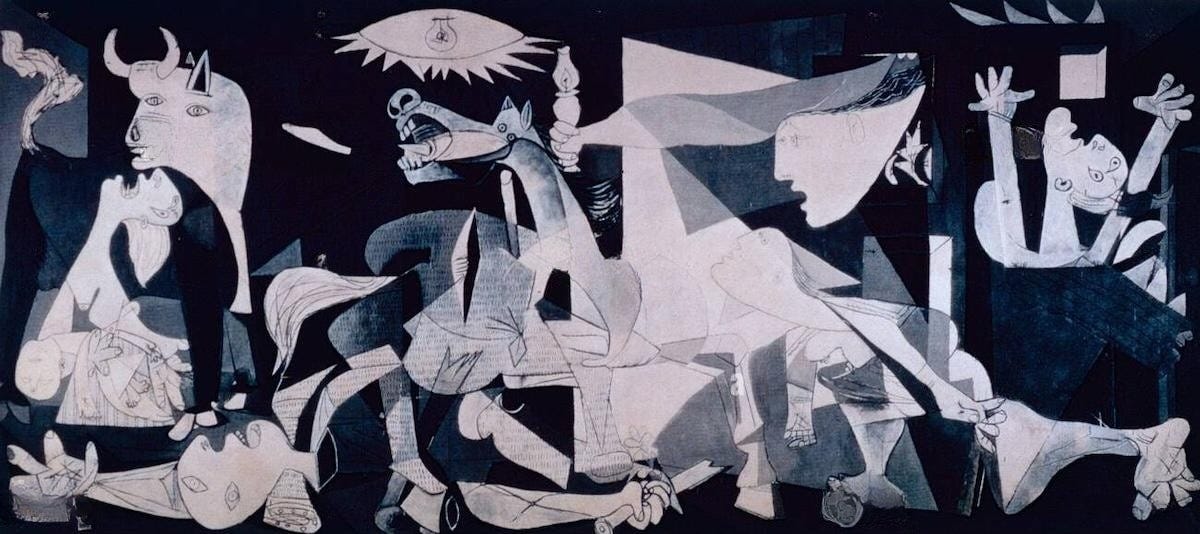
•Guernica: Picasso’s 1937 painting depicting the fascist bombing of the eponymous town in Spain. What creature, though?
•Mondrian: See p. 297n. The joke is that whatever Mondrian is, he is not a “realist of the old school.”
•sitar music: As was popular some time before the book takes place, ca. Sgt. Pepper’s (1967).
p. 299
•pavé: A Brazilian desert reminiscent of a tiramisu.
•circular movement: Always cycles.
•bees hunting for a hidden flower: Proust again. See p. 230.
•Simon: I.e. Simon Magus from p. 298n.
p. 300
•put a beard on him: Return of the beard as disguise theme. See p. 79n.
•Ennoia: see p. 41
•Demiurge: see p. 14n
p. 301
•prostitute: Returning to the epigraph.
•Helen of Tyre: Traditional companion of Simon Magus. Longfellow writes
He [sc. Simon Magus] says: “From this evil fame,
From this life of sorrow and shame,
I will lift thee and make thee mine;
Thou hast been Queen Candace,
And Helen of Troy, and shalt be
The Intelligence Divine!”
•“bonfires along the highway for truck drivers”: This is just curious. I don’t understand.
•Guillaume Postel: Sixteenth-century French polymath and kabbalist. Cf. Vivian Postel du Mas (another real person, doubtless unrelated and four-hundred years later but sharing a name) on p. 315.
•a letter carrier: We await silent Tristero’s empire.
•Superman: Another comics reference. And Superman handily picks up the Jewish reference from the previous line…
p. 302
•“I love you”: And yet, as Byron writes (Don Juan VI): “And I love Wisdom [i.e. Sophia] more than she loves me.” See also p. 343, epigraph.
p. 303
•Allumeuse: Fr., a tease or a flirt.
•beyond good and evil: An obvious Nietzsche reference.
•perpetrate all sins: As some heretical sects, such as the Historioni in Borges’s “The Theologians” (1949), were said to attempt.
•“I am the saint and the prostitute”: An even more explicit reference to the epigraph.
p. 304
•cock-a-doodle-doo: Either an evocation of madness or a reference to cuckoldry—both the homophonous pun and the fact that a cuckold (at least in the German tradition) was called, and imagined as, a “rooster rider” (Hahnreiter).
Chapter 51
p. 305
•epigraph: The title translates as: Theatre of Various and Diverse Worldly Minds. Garzoni wrote (although perh. not in the quoted book; I’ve never read it) against and in refutation of Agrippa, the guy who provided the epigraph to the whole of FP (q.v.).
•Deutsches Museum: “The world’s largest museum of science and technology” (Wikipedia).
p. 306
•Marlowe of culture: Once again I proffer the question: Philip or Kit?
•bowels of the earth: Always subterranean.
•cellars: More subterraneanity. Surely a suggestion of “The Cask of Amontillado.”
•crèches: A crèche is on the one hand nativity scenes (suggesting a subterranean display, which might indeed call for (“ox and lamb”) stuffed animals; it is on the other hand a daycare center, which would, perforce, require another kind of stuffed animal. Perhaps giving children taxidermied specimens to play with sounds outre, but we’re already underground.
•“in the light of the sun or the moon”: I have not really been keeping track well, but I do think something could be done with the various kinds of light in FP: solar, lunar, crepuscular.
•“I’m suspicious of everything underground”: Well there you have it.
•sewers of Paris: see pp. 8 & 350
p. 307
•mouth of the underworld: Avernus, Roman entrance to Hades, was famous for emitting such fumes that birds flying overhead fell dead.
•journey to the center of the earth: Obv. subterranean, but even more obv. a Jules Verne reference, so see below.
•Master of the World: Master of the World, like Journey to the Center of the Earth, is the title of a Jules Verne novel.
•Saint-Yves d’Alveydre: see p. 309, right below
p. 309
•epigraph: As will be revealed shortly, Saint-Yves d’Alveydre was a French writer who visited Agarttha (see p. 4) in the hollow earth. “He wrote about this secret location in his Mission de l’Inde en Europe [India’s Mission in Europe] published in 1886. Worried he had revealed too much and apparently under the influence of his oriental contacts, he destroyed all but two copies of this book. One of which was owned by Gérard Encausse alias Papus [see p. 209], who edited and published it in 1910” (Wikipedia).
•Fabre d’Olivet: Antoine Fabre d’Olivet was a (French) revolutionary and also another hermeticist—but I want to pause on him here in light of Mission de l’Inde en Europe, because Fabre d’Olivet was born in Ganges (the French commune, not the Indian river, but still).
•humble clerk: I underlined these words and wrote next to them “Manutius” but I no longer remember what I meant. Can anyone help me here?
•Ministry of the Interior: Get it? Like Agarttha?
p. 310
•mésalliance: I.e. she married beneath her station.
•enharmonic spectrum…diatonic: Agliè has borrowed terms from (esp. ancient Greek) musicology: enharmonic and diatonic are two kinds of scales—the enharmonic scale has smaller intervals between notes than the more familiar diatonic scale. Somewhat oddly, the third kind of scale, chromatic, is the most directly related to the spectrum of visible light—but it goes unremarked upon here. Too exoteric, I guess.
•solar spectrum: But yeah, what I was saying on p. 306 about the different kinds of light…
•cyclic currents: Aways cyclic!
•interpolar and intertropical fluids: On p. 257 I made fun of the word fluids, but I guess it’s all here. Note that you can’t spell interpolar without Interpol.
Chapter 53
p. 312
•epigraph: J. M. Hoene-Wronski is the Józef Wroński from p. 258.
•wispy beard: Beard as disguise.
p. 313
•Eschenbach: Author of Parzival; see p. 141. I don’t remember this detail about going to India, but it’s been a long time since I read the poem.
p. 314
•a short circuit in the brain: De Angelis’s makes connections like Abulafia, and his description cannot help employing a computer metaphor.
p. 315
•“everything is connected”: I.e. tout se tient. See pp. 179, 289, & esp. 618.
•philosopheme: “A philosophcal formulation or principle: proposition” (MW).
•squats: see p. 297
•Action Française: Long lived far-right nationalist French group.
•Vivian Postel du Mas: Note the repeated Postel from p. 301.
•Jeanne Canudo: More commonly known as Valentine de Saint-Point, French Futurist.
•Fabian: The Fabian Society, a peaceful British socialist organization dedicated to amending society gradually, and not through revolution (a Fabian strategy, so-called). H.G. Wells & G.B. Shaw were not only members but kind of just emblematic of the vibe.
•Revue internationale des sociétés secrètes: Obv. this is the International Review of Secret Societies, an early C20 French journal, “rabidly anti-Semitic, biased, hateful and credulous to a degree that is hard to believe” (IAPSOP).
•La Sapinière: A.k.a. Sodalitium Pianum. Pope Pius X’s secret goon squad (1907–1914). Pope (avant la lettre) John XXIII was a member.
•cénacle: Fr., inner circle. More discussion on p. 360n.
p. 316
•”So it seems also to me, O Socrates”: Echoing Plato’s Socratic dialogues, passim.
• “I don’t know what Martinist means”: It really is confusing! See p279n.
•Front Populaire: A big-tent alliance of left-wing French groups, banded together against fascism.
•La Cagoule: Violent French right-wing group. We are scarcely out of conventional exoteric history here.
•Du Mas: I.e. Vivian Postel du Mas from the previous page, but note that the capitalization has changed. (Also Eco often cites the other guy named Dumas (3 Musketeers etc.…)
•Synarchie, panorama de 25 années d’activité occulte: Synarchy, an Overview of 25 Years of occult Activity.
p. 317
•Pétainist: Marshal Philippe Pétain was head of the Vichy French (i.e. collaborationist) government.
•Le 14e complot du 13 mai: The 14th Plot of May 13th.
•“As the man said”: The man, in this situation, is H.L. Mencken.
•“if, on a train, I find a bomb”: see p. 556
p. 318
•Tres: Its origin, in De Angelis’s obiter dicta. Tres is o.c. Spanish for 3, and homophonous with “trace”; a word that leaves but a trace?
Chapter 54
p. 320
•epigraph: For the record, Edgar is acting mad when he says this.
•“a gentleman of the old school”: So to speak.
•Turin: see p. 260n
•“a whole world to be discovered”: Cf. p. 202: “…it had hardly been worth crossing the Atlantic to discover a new world.”
p. 321
•glissons, à la guerre comme à la guerre: Fr., Let’s move on. In war you take it as it goes. Not the last time Garamond will say this (see p. 348).
Chapter 55
p. 323
•epigraph: For Fludd, see pp. 197, etc. For theaters, see pp. 282 etc.
•Adelino Canepa: see pp. 292ff.
•both visible and concealed: An unusual detail to spot at a glance. But o.c. thematic.
p. 324
•Georgic: As in relating to the Virgilian Georgics; rural/agricultural.
•wily Turk: A stock phrase, and perhaps a reference (“the first move”) to the Mechanical Turk, a (fraudulent) C18–19 chess-playing robot.
•Salesian: A Catholic “religious congregation”; perhaps not strictly a fraternal organization (like the Masons) but the next best thing.
p. 325
•the dream: see pp. 60–61
•bombardon: A bass tuba.
•“the partisans…occupied the town”: This statement seems to contradict one later in the same paragraph that “The Fascists mostly stayed holed up in the town.” My assumption (from the broader context) is that the partisans occupied the fields of the plain, and the quoted passage is simply an error.
•Franchi brigade: The Organizzazione Franchi; monarchist, liberal, anti-communist, and o.c. anti-fascist.
p. 326
•“what a memory!”: A strange thing, I think, to say to the narrator. A few documents aside, Casaubon’s memory is all the reader has. And perhaps Casaubon has learned a few of Agliè’s theater of memory tricks (p. 283).
•Black Brigade: Fascist paramilitary organization.
p. 327
•red or black: A Stendhal reference.
•“A corpse was a corpse…”: And now a Gertrude Stein reference.
•Combray: A village, the setting of (part of) Proust’s In Search of Lost Time; the first part of the first volume of which is titled “Combray,” and it ends with the famous madeleine episode.
•John Wayne: Note how the cowboy theme is undercut on the next page. Should probably be viewed as a reference to Jacobean drama, as Wayne’s signature director, John Ford, shares a name with the old (’Tis Pity She’s a Whore) dramatist. Or is that too much?
p. 328
•Hellzapoppin: An absurdist 1941 comedy film (and earlier stage musical, although clearly the film is meant here).
Chapter 56
p. 329
•epigraph: This appears to continue directly from the epigraph to Chapter 9 (p. 59).
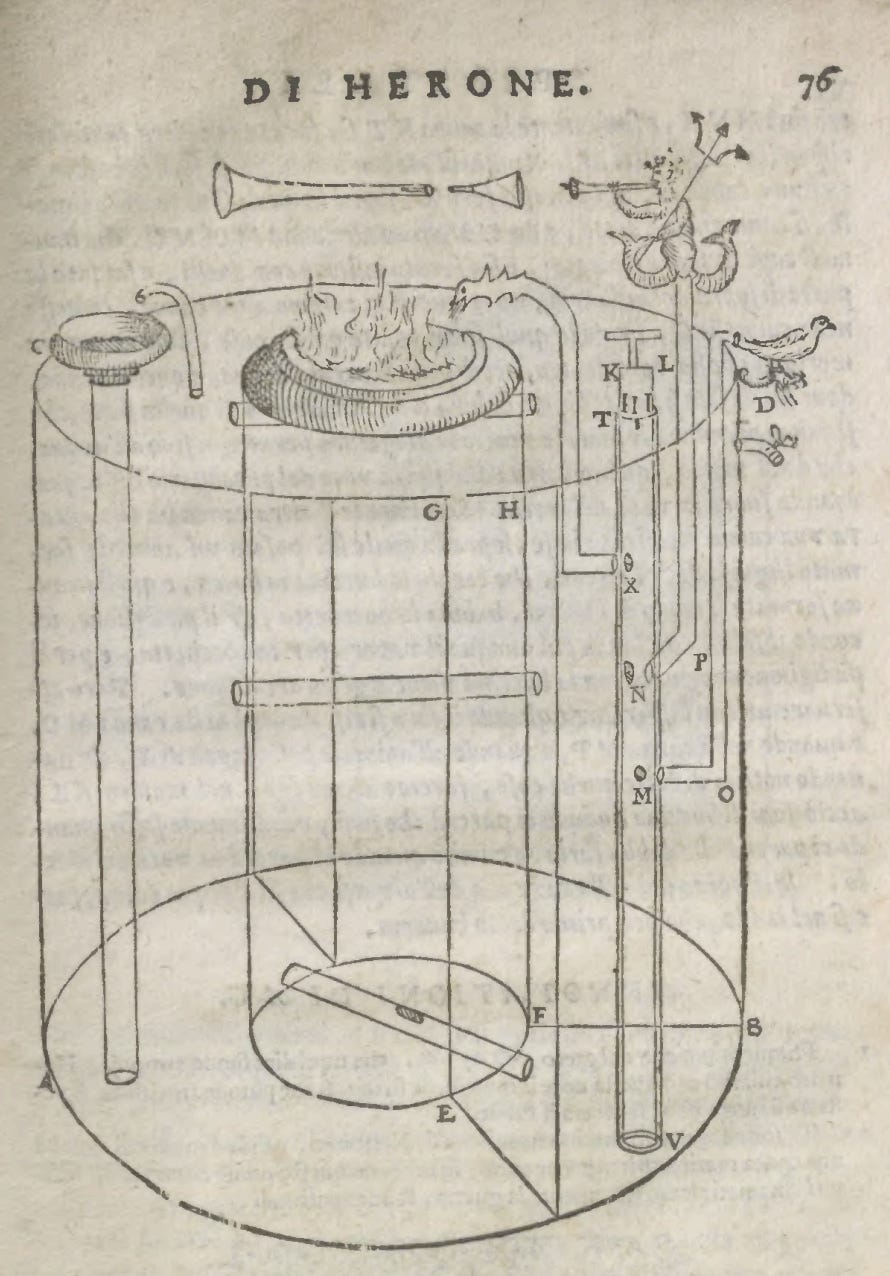
•Spiritalia of Heron: Here’s Hero of Alexandria from p. 14 again, the book his Spiritalia seu Pneumatica (the title just means Pneumatics or Pneumatics, the two linked synonyms just representing Latin and (Latinized) Greek). Here’s a sixteenth-century engraving from the book, this one from an Italian translation (Spiritali di Herone Alessandrino).
•Tycho Brahe: Just an old Danish astronomer; just a joke. Tycho’s most famous feature is his missing nose, and here Casaubon “knows not” the correct name of Belbo’s teacher. Cf., though, “what a memory!” from p. 326. Is Casaubon just having us on?
•Domenico Savio: Student of Bosco’s (below); died Æ14 in 1857 and later canonized.
•Don Bosco: John Bosco, C19 priest and teacher; also canonized.
•embouchure: Honestly, embouchure—the positioning of the mouth when playing an instrument—does not usually refer to a callus.
•“not to puff out your cheeks”: Louis Armstrong (from two sentences earlier) is o.c. famous for doing just this (though not as much as Dizzy Gillespie, or perh., as Eco says, cartoon characters).
p. 330
•Ornette Coleman: Free-jazz saxophonist, and—there’s a lot to hate about saxophones, but this seems a strange place to draw the line.
p. 331
•“I believe all sin, love, glory are this…”: Eco’s (and Belbo’s) most beautiful passage.
•“perpetuation of the vile species”: Cf. Borges, “Tlön”: “Mirrors and copulation are abominable, because they both multiply the numbers of men” (and see p. 13n).
•warlike, angelic, apocalyptic, victorious: A litany of biblical (and extra-biblical) trumpet associations, leaning most perh. on Joshua 6:5b (“and when ye hear the sound of the trumpet, all the people shall shout with a great shout; and the wall of the city shall fall down flat”) and the various verses on “the last trump” (e.g. 1 Corinthians 15:52).
•Oscar Levant…Gene Kelly: Oscar Levant was frequently Gene Kelly’s pianist, although not on Broadway. Perh. a reference to the scene in Kelly’s American in Paris in which Levant imagines himself playing “Concerto in F” on Broadway?
•Salgari: Emilio Salgari, turn-of-the-century writer of pulpy adventure stories. See p. 357.
•“Sitting Bull eats General Custer’s heart”: Not actually a historical fact, although one of Sitting Bull’s allies (Rain-in-the-Face) did threaten to eat Custer’s brother’s heart. Apparently he did not get to.
•“they stole comic books”: Infamy!!!!
p. 332
•I quite clearly wrote “rtvadlk” at the top of this page. Any ideas on what I meant?
•“my little listeners”: Even when Belbo is speaking he cannot help but slip into kitsch.
•They Had to See Paris: A 1929 talkie comedy film. I don’t know if they’re putting on a dramatization of it or just showing an old movie?
•“Good Start”: I wish I had a better grip on whether this is a performance or just an intro to a film.
p. 333
•imagining absurd machines: Perh. a suggestion that the invented Plot is, in fact, not original?
• “only to discover, each time, that the machines had already been invented”: Cf. (perh. not for the last time) Eco’s own Open Work: “…everything in the world is already implied by everything else, from the beginning of time, in the same way that it now appears that every discovery has already been made by the Chinese.”
•as the poet says: The poet is Baudelaire, the poem “Hymne à la Beauté / Hymn to Beauty.” English translations tend to make the mayfly a moth, but in the original it’s “l’éphémère” (with a pun on mayfly / ephemera, a pun available in Italian as well. Google translate gives the poem as:
The dazzled mayfly flies toward you, candle,
Crackles, flares up, and says: Let us bless this flame!
Chapter 57
p. 335
•epigraph: This is the third epigraph from The Chemical Wedding (and will not be the last); it is the only one not about a trumpet. A virgin dressed in blue always suggests the Virgin Mary.
•”Like Darién, Diotallevi remarked, verbalizing these discoveries”: Darien would be from whence Balboa “star’d at the Pacific.” Keats, who famously misidentified Balboa as Cortez, calls the observer “silent upon a peak in Darien,” so by “verbalizing” the sight, Diotallevi ruins the moment.
p. 336
•third gear: Presumably not a metaphor; presumably just because they’re going uphill.
•Mercedes: On p. 284, Agliè says that the Oedipus Aegyptiacus “costs less than a Mercedes.” To me, Mercedes will always suggest the Count of Monte Cristo’s ex-girlfriend, but perh. that is not relevant here.
•Eleusinian: Spelled “Eleusian” on p. 275.
•fumes: Always fumes and odors.
•“dream that you are dreaming”: Cf. Poe: “All that we see or seem / Is but a dream within a dream.”
p. 337
•Salomon de Caus: Architect and engineer, he will appear again on pp. 401 & (subterraneanly) 460 (as well as pp. 338 & 350). I can find no evidence that he was himself a Rosicrucian, but certainly people (both inside and outside FP) have later attributed Rosicrucian motives to him. Note that he is sometimes called Caus, reminiscent, perh. of Casaubon.
•the great Rosicrucian century: C17.
•rocaille: “Rocaille was a French style of elaborate design that appeared in furniture and interior decoration during the early reign of Louis XV. A reaction against the heaviness and formality of the Louis XIV style, it featured an abundance of curves, counter-curves, undulations, and elements modeled on nature” (Wikipedia). Note that rocaille comes around a century after de Caus’s death.
•Atalanta Fugiens: Source of the epigraph of Chapter 4, p. 28 (q.v.).
•coral: Coral horns, the good luck charms, appear on pp. 163 & 177. If Maier had written seashells instead of coral, this would have anticipated Lia’s Chapter 63 speech (see pp. 201 & 362ff).
•“we can no longer read it”: Much like (for much of history) “the hieroglyphics of the Egyptians” (mentioned immediately above).
p. 338
•some small structures: These descriptions recall the edifices described in the Hypnerotomachia Poliphili (1499), although I haven’t been able to find any actual correspondences.
•Picinelli: Filippo Picinelli, C16 Italian author of Il Mondo simbolico, an encyclopedia of emblems, or as we might say (Eco the semiotician) signs. The book takes images and describes, with attestations, their various symbolic importances. IMs was translated into Latin as Mundus Symbollicus.
•Alciati: Nickname of Andrea Alciato, C16 Italian humanist and author of the Emblemata, a completely different kind of emblem book. Alciati’s is a book of epigrammatic Latin poetry, and was later reprinted with emblematic illustrations accompanying each poem. Alciati dies only three years before the appearance of Il Mondo simbolico.
•sublunar: see p. 3n
•ruling the universe: Just as the earth is ruled from its center (Agarttha) so the universe is ruled from its center (Earth—at least Ptolemaically).
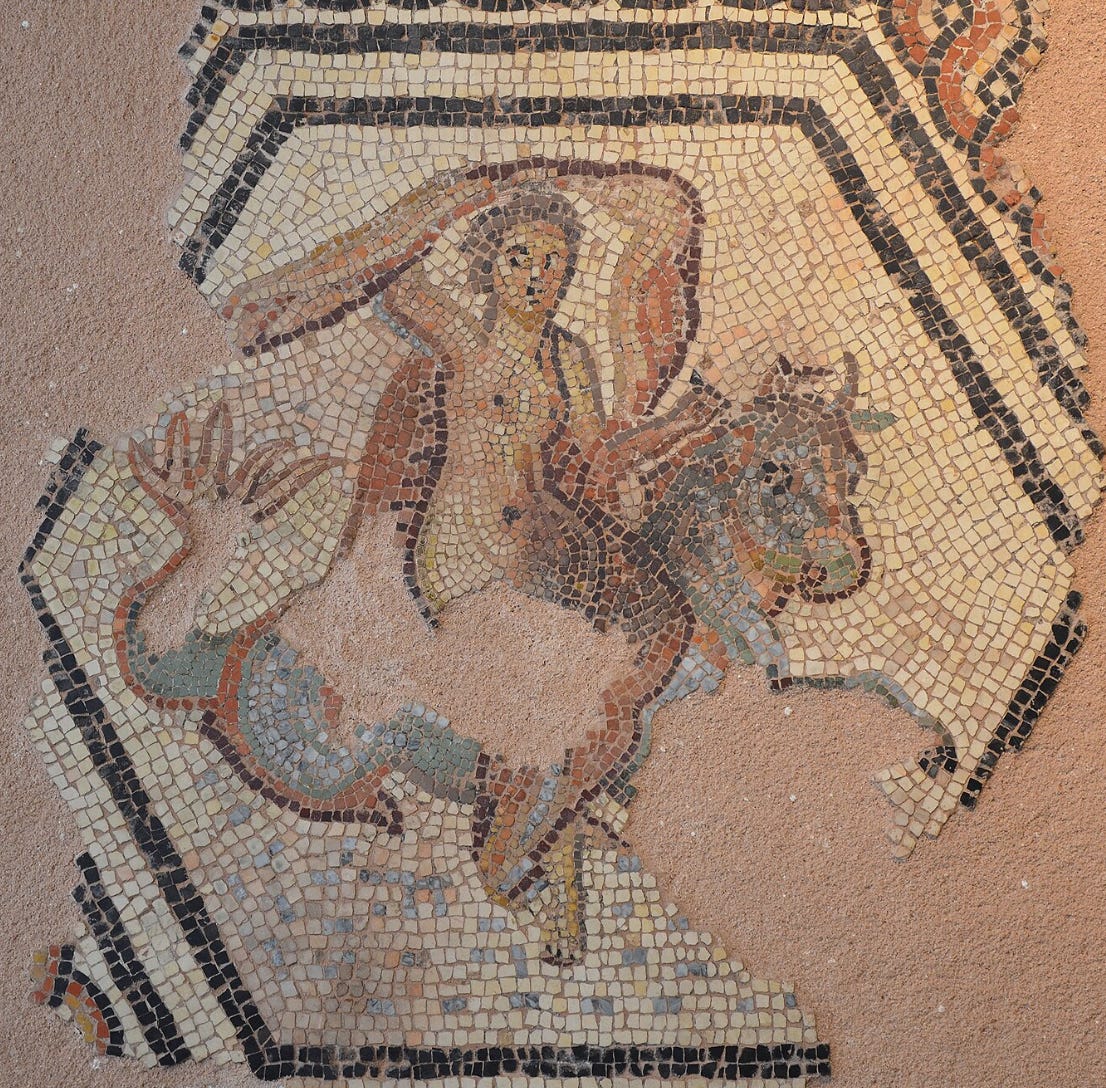
•“naiad…embracing a bull with the scaly tail”: Perh. the image actually depicts Europa and Zeus, his bull-form given a fishy tail in, e.g., this mosaic.
•“some great biblical fish”: Jonah 1:17a: “Now the Lord had prepared a great fish to swallow up Jonah.”
p. 339
•Nequaquam vacui: Usu. rendereed (e.g. on p. 193, q.v.) nequaquam vacuum. Is Agilè confusing the common phrase nequaquam vacuum with the common phrase horror vacui (horror of a vacuum)? Or is this a legitimate use of the genitive case?
•post hoc ergo ante hoc: Here made manifest is a concept we have encountered time and time again. An important concept for Eco—see his Interpretation and Overinterpretation (1990).
•facies hermetica: see p. 267
•“What counts, remember, is to possess a secret”: Agliè’s mantra.
p. 340
•Quod ubique, quod ab omnibus, et quod semper: The so-called Vincentian canon, a threefold test of canonical Catholic belief, formulated C5 by St. Vincent of Lérins. One must believe what has been believed (as the Latin says) “everywhere, by everyone, and always.” Here the canon is being used somewhat contrary to its intended use (of establishing dogma).
•“a girl wrapped in a blue garment spangled with golden stars. In her hand she held a trumpet”: Note the connection to various previous quotations from Andreae on pp. 329 & 335.
•wings…eye: Wings with eyes are a feature of esp. Byzantine angels.
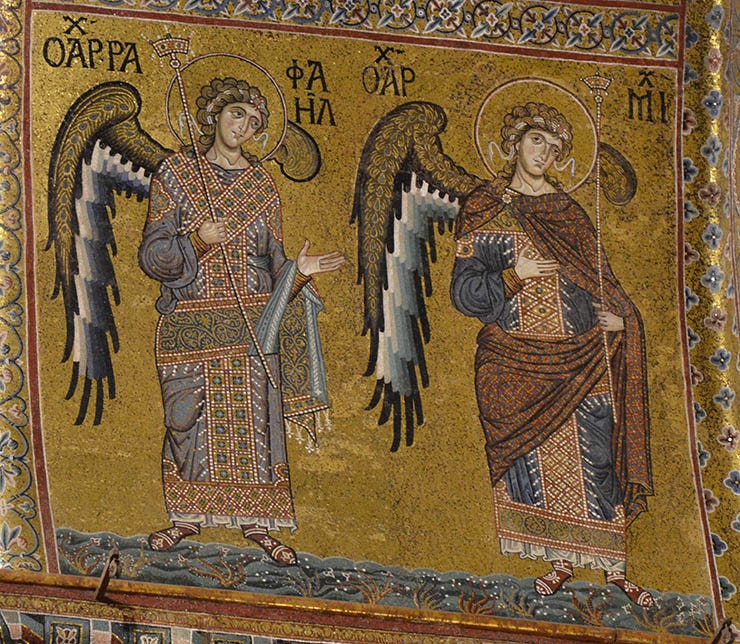
•“more things in heaven and earth”: Garamond is quoting his own imprint, Project Hemes, ellipsis and all; see p. 265.
•CONDOLEO ET CONGRATULATOR: Lat., condolences and congratulations. Another reference to The Chemical Wedding. In a passage somewhat anticipating Kafka’s “Before the Law” (1915), the narrator spies a gate with “two columns on one of which stood a pleasant figure with this inscription, Congratulor. The other having its countenance veiled was sad, and beneath was written, Condoleo.” Jung famously cites this passage in his Mysterium Coniunctionis (1955).
•“through the curtain”: Should I have made a bigger deal of this before? Perceiving things despite the barrier of a curtain suggests a host of allusions, including the rending of the temple curtain (Matthew 27:51 etc.) and the exposure of the Wizard of Oz.
p. 341
•bilocation: Pythagoras (q.v.) is perh. the most famous (and first? practitioner of this technique.
•yogis: Yoga practitioner. The gravity of the term yogi has been somewhat subverted by more modern allusions.
•vegetable essences: Cf. the “ vegetable lethargy” of the soulless homunculi (p. 346).
•telluric form: Although telluric forces run through FP almost from the beginning (pp. 11ff), this is the first time it is linked to teleportation.
•musée Grévin: Parisian wax museum. An Anglophone writer would have used Madame Tussauds.
•tenda de umbanda: see p. 176
•Lenci felt: “Lenci dolls are wool felt dolls that feature heat-pressed wool faces with painted features. They typically have intricately made wool and organdy clothing, adorned with elaborate felt flowers, hats, and/or accoutrements. They are at the top end of the luxury goods market. Today they are considered highly prized collectibles” (Wikipedia).
•Gabrieli: Giovanni Gabrieli, renaissance Italian composer.
•Black Madonna: See p. 145 in general, but perh. esp. La Morenata, the Virgin of Montserrat, a sacred Catalonian statue.
p. 342
•Hamlet: Hamlet, o.c., has been quoted as recently as p. 340.
•Madame Bovary: For the reality of Emma Bovary, recall Flaubert’s quip, “Madame Bovary, c’es moi,” and Woody Allen’s 1977 short story “The Kugelmass Episode” (pdf).
•epiphanies: Lit. appearances or manifestations.
•Golden Calf: Aaron’s heretical idol in the desert (Exodus 32:4).
Chapter 58
p. 343
•epigraph: Trithemius last appeared on p. 133–34. His text describes allegorically Belbo’s relationship with Lorenza.
•“that had first struck me as cheap”: High and low, art and kitsch, are again confused (as, e.g., in FP’s dabbling in genre conventions).
•subaqueous: For once not subterranean!
•“the floor reflected the ceiling”: As above, so below, as Hermes Trismegistus (see p. 14) would say.
•Indian incense: More vapors!
•“two reptiles…a single circle”: For reptiles biting their tails see p. 195. In alchemy, the canonical chemical wedding is the marriage of sulfur (red) and mercury (usu. white but due to its associations with water also possibly blue)—so here that conjunction of opposites is represented visually (as was the custom in alchemical texts). Cf. the dueling dragons in the Prophecies of Merlin (Prophetiæ Merlini) by Geoffrey of Monmouth (ca. 1135), in which the dragons were colored a more conventional red and white—but there the gloss on their meaning, from Merlin, is historical and not alchemical.
p. 344
•Rebis: “The Rebis…is variably identified as either or both the end product of the alchemical magnum opus (or great work) or/and the initial state of matter. It is heavily associated with the principle of hermaphroditism, or the combination of the male and female sexes into one being” (Wikipedia).
•Work of the White: The four phases of alchemy’s Great Work are (in order) black, white, yellow, and red. This one’s a purifying phase.
•White Copper, Immaculate Lamb, etc.: This list appears to come primarily if not entirely from the works of Antoine-Joseph Pernety (e.g. the 1898 translation An Alchemical Treatise on the Great Art).
•nuptial banquet: What follows is an approximation of the fourth day of the Chemical Wedding. The parts that recall the Grail quest—elderly king, banquet, warrior—are all in the CW original.
p. 345
•pendulum: !!!
•“Lorenza was gone”: Thus she disappoints all, as promised on p. 341.
•carbuncle: Borges, in his Book of Imaginary Beings (1957/1967), describes the carbuncle as a legendary beast with a glowing gem in its forehead. Also a term for a gem, of course, but this one illuminates.
•alembics: see p. 279n
p. 346
•fumes: Again!
•a bird: Clearly a type of the phoenix (radiant/ashes).
•golden trumpets: I’m just saying.
•insufflate: To blow something into something else—usu. a medicinal powder into a patient.
•Mysterium Magnum: Lat., great mystery, o.c. “Paracelsus and other alchemists employed the term ‘Mysterium Magnum\’ to denote primordial undifferentiated matter” (Wikipedia).
•a Thing: The ding an sich, the thing in itself—Kant’s term for reality as it really is, as opposed to how it is perceived. What the Great Work is groping for, at least for some.
Chapter 59
p. 347
•epigraph: Despite the many references to his work and thought, this is actually only the second appearance of Paracelsus in FP (after p. 133). The quotation is really too on point.
•measurements: Cf. the kiosk on p. 288, but more appositely Simon Studion on p. 196.
p. 348
•Cartesian imps: AKA Cartesian divers, a science-fair experiment or novelty device that bobs up and down in a bottle of water, apparently of a will but actually due to principles of buoyancy.
•automata: FP’s fear of automata starts way back on p. 11; see also p. 283n (“claim a miracle”).
• à la guerre comme à la guerre: Another stock phrase of Garamond’s; see p. 321.
•agogô: See p. 164 and esp. 212–13
•philter: see p. 231
Chapter 60
p. 349
•epigraph: Artephius “a writer to whom a number of alchemical texts are ascribed. Although the roots of the texts are unclear and the identity of their author obscure, at least some of them are Arabic in origin” (Wikipedia). Note that the presence of a labyrinth is always a Borges reference.
•“like the bell of a trumpet”: Hmmm.
•Ear of Dionysius: A cave with special acoustics through which the tyrant Dionysius of Syracuse would eavesdrop on prisoners kept therein. The famous whispering gallery in Grand Central Station, NYC, is another example of such a place.
•“I’ll tell you something I’ve never told anyone else”: The following lament comes sometimes word for word from Antoine-Joseph Pernety, op. cit., where it is ascribed to the fifteenth-century English alchemist George Ripley.
•soul of Saturn: Another name for the the Prima Materia—i.e., the prime material, the philosopher’s stone, perh. the Rebis.
•aes ustum: Lat., burnt copper (or bronze). An old term for copper oxide.
•saffron of Mars: Iron oxide.
•aqua vitae: Lat., water of life. Alcohol.
•sperm of the stars: Various ancient legends ascribe power (usu. ill) to matter emitted from the stars, but I don’t know what in particular Eco, Balsamo, Pernety, or Ripley is referring to here.
•chelidon: Martin Rulandus’s Lexicon of Alchemy (1619) defines chelidonia as gold and chelidonius as any one of several kinds of precious stones with magical properties, often found inside swallows or tortoises. Take your pick what is used here.
•placentas: !!!
• “even…”: “What counts, remember, is to possess a secret.” R.H. Blyth wrote (Zen and Zen Classics vol. 4 (1966)): “Zen is this row of dots,” but perh. we are just better off not knowing what comes after placentas. Ripley himself trails off before this part of the list (“and an infinity of other things”).
•Balsamo: Giuseppe Balsamo, the real name of Cagliostro (q.v.). Now, the question is: Are we supposed to recognize this as a character, one of the Diabolicals? Another alias for St. Germain? Or is it a one-off joke?
p. 350
•Heidelberg…Caus: see p. 337
•Malraux: Novelist Andre Malraux, as Minister of Cultural Affairs, cleaned off the filthy façades of Parisian buildings.
•sewers: Both the subterranean theme and Salon’s particular bugaboo; see p. 308.
•Cloaca Maxima: Lat., greatest sewer. Rome’s ancient sewer.
•Colbert: Jean-Baptiste Colbert, First Minister of State under Louis XIV. Perh. significantly, since we’ve been talking about architecture, his sewer project began in 1666, the year of the Great Fire of London, which disaster allowed the rebuilding of London along new lines (Wren, etc.).
•Man in the Iron Mask: Both a real prisoner under the reign of Louis XIV (about whom much speculation) and the title of a Dumas novel (in which the masked prisoner is the king’s twin brother).
p. 351
•Ça alors: Fr., Well I’ll be.
•tapis franc: Fr., “a low or unsavoury tavern or cabaret; sot-hole, grog-shop, pothouse” (Wiktionary).
•pègre: Fr., “underworld, mob (part of society that is engaged in crime or vice)” (Wiktionary).
•Légendes: Fr., legends, obv.
p. 352
•rocaille: See p. 337, but isn’t the grammar weird here?
•phonurgic: Relating to the science of acoustics.
•Nibelungs: see p. 72
p.353
•epigraph: Arcanum Hermeticae Philosophiae Opus = Arcane Work of Hermetic Philosophy. Three heads of water, earth, and air, leave only the traditional dragon element of fire. References to the Golden Fleece abound in FP, but usu. concerning the Oder of the Golden Fleece: see pp. 144, 197, 354, 382, 401, etc.
•“those characters in Greek myth”: E.g.g: Actaeon, Tiresias, to some extent Semele (not “the wrath of the gods” but natural consequences there). Cf. Orpheus.
•“tinfoil or some metal leaf, gold and silver”: Again what is low is confused with what is high. Since this is tin and gold, the confusion points not only to Hermes Trismegistus (as above, so below) but to alchemy (transmuting base metals to gold). Note that tinfoil is what paranoids use to make their hats.
•“set in motion by the flames”: As in an eolopile—see p. 14.
•“precious stones—or bits of glass”: High and low again.
p. 354
•Renaissance portrait: This portrait of Prince Eugene of Savoy has the medallion around his neck, not his waist, but was the best I could find.
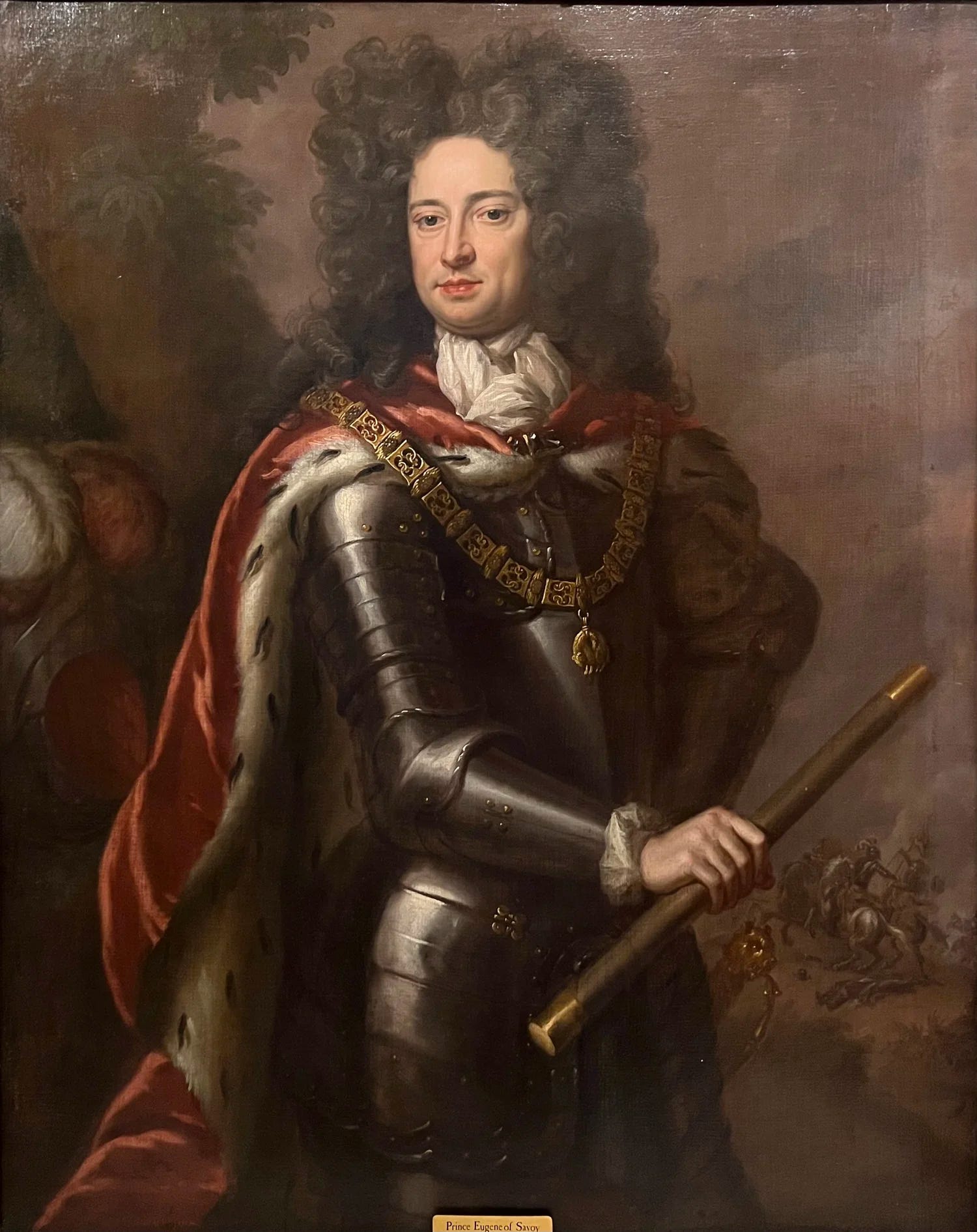
•stilettos or paper knives: Again the linking of opposites.
•Pink Panther: The cartoon character, of course, who walks to a mellow Henry Mancini jazz score.
p. 355
•San Gennaro: St. Januarius, patron saint of Naples; his blood (stored in an ampoule) miraculously liquifies on holy occasions.
Chapter 62
p. 356
•epigraph: Les druides. Les sociétés initiatiques celtes contemporaines = The Druids: Contemporary Celtic Initiatory Societies.
•Little Red Riding Hood: Presumably that they are on their way to be eaten by a wolf? Note that Casaubon’s prodigious memory (p. 326) has (“I don’t recall it exactly”) failed him here.
•Mikil: This I can find nothing on.
p. 357
•“Certain places have more magic than others”: Elementary tellurism.
•”the three hallouines of Lisieux, Clonmacnoise, and Pino Torinese”: Hallouine of course suggests Halloween, but I can’t get past that. Pino Torinese is right next to Turin (p. 260n), though. (Clonmacnoise is a ruined Irish monastery.)
•dolmen: An ancient megalithic tomb; a flat stone roof balanced atop two or three pillars, creating a kind of chamber.
•“blew a trumpet”: Yes, yes.
•Aïda: The Verdi opera set in ancient Egypt: see p. 260n. This is the triumphal march.
•ramsing: Usu. ramsinga, a sigmoid copper Indian trumpet [!]. Belbo (characteristically) is invoking Salgari’s Mystery of the Black Jungle (1895): “Beneath the earth [!] the mysterious roar was heard for the third time, and from the trunk of the banyan tree rang out the clear, brassy note of the ramsinga.” In Salgari, the Thugs are being summoned.
•Thugs: Here, o.c., murderous Kali-worshippers.
•subterranean currents: A more overt discussion of what is often…underground.
p. 358
•sibyl: see p. 275n
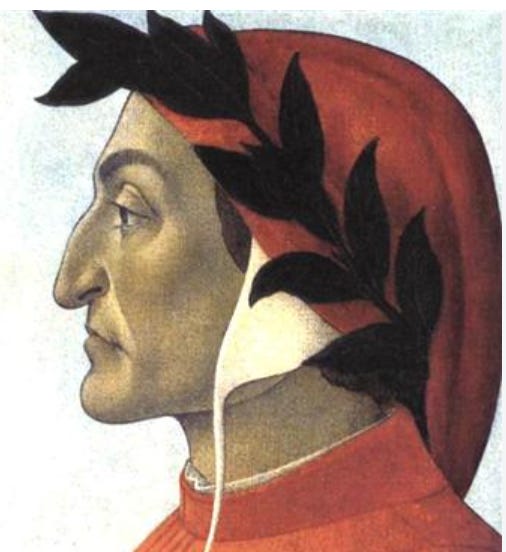
•Dantean nose: Check out Dante’s nose:
•cicatrix: A scar. A word to rhyme with Picatrix, q.v.
p. 359
•“O pegnia (oh, e oh!) et eee uluma!!!”: I cannot translate this, but I want to say that the Italian original has “O pegnia (oh, e oh! intus) et eee uluma!!!”—why did Weaver drop the intus? Also: note those three bangs (!!!); Eco doesn’t use that trick again!
Chapter 63
p. 360
•epigraph: A surprisingly accessible (esp. to English speakers) source.
•Réaumur cylindrical stove: More commonly called a cupola furnace; invented or reinvented in the C18 by French entomologist (!?) René Antoine Ferchault de Réaumur.
•Deutsches Museum: see p. 305
•astrological cénacles: A cénacle in an upstairs room, and in Christian parlance a prayer group. Presumably the astrological minded have similar gatherings? Easier to stargaze from an upstairs room. But see also p. 315n for perh. a simpler explanation.
•Newton: Famously Newton added extra colors (incl. spurious indigo) to the spectrum to ensure there were seven colors matching seven musical notes matching seven planets. And all the other relevant stuff about Newton.
•“I’m like Amparo; I don’t believe in it, yet I surrender to it”: This is stated perh. most explicitly on p. 617.
p. 361
•Celtic and Amerindian: Not the two I would have picked. Perh. the existence of fairy folk / wee folk over and around the realm of humanity?
•file of cross-references…thin as a rail: One would expect Eco to jokingly follow a mention of the file with an immediate reference, but he subverts our expectations by providing two absolute cliches (one verbal, one (the mothering Italian woman encouraging food consumption) situational that are too widespread to be a reference to anything.
•Coney Island, Moscow May Day, Jubilee Year: At least here Eco gives us what we want—analogies in defense of analogies. Coney Island is the iconic fairground, May Day (international workers’ day) is of course a party in Soviet Russia, and Jubilee in ancient Israel was every fiftieth year (Leviticus 25) when debts were forgiven, etc.
p. 362
•serene wisdom: Cunningly, Lia’s speech is a microcosm of FP and the Plan.
p. 363
•hippopotamus: “Another intriguing behavior of hippos is that they roar in the morning at sunrise and in the evening at sunset. The Egyptians possibly interpreted this behavior as a greeting and farewell to the sun. And the sun’s travel was seen as an eternal cycle of rebirth that the deceased hoped to join. Hippopotami were thus associated with life, regeneration, and rebirth” (Met).
•Sphinx: See p. 177. A reference, o.c., to Oedipus’s riddle specifically.
p. 364
•menhir: Prehistoric standing stone; a proto-obelisk. Freudian, o.c. (as is, usu. Oedipus, immediately above, right?).
p. 365
•pregnant: Thus Lia’s model of the universe bears fruit, so to speak.
•“we had entered Gevurah”: In fact, we had entered Gevurah on p. 217.
•Moses Cordovero: C16 kabbalist. “His encyclopedic works became a central stage in the development of Kabbalah” (Wikipedia).
Previous installments: